涓枃绠€浣?/a>銆€|銆€


| Blast from the Past: Xi'an's History Still Flavors Modern City | |
http://english.dbw.cn銆€銆€
2010-10-21 10:44:10
|
|
|
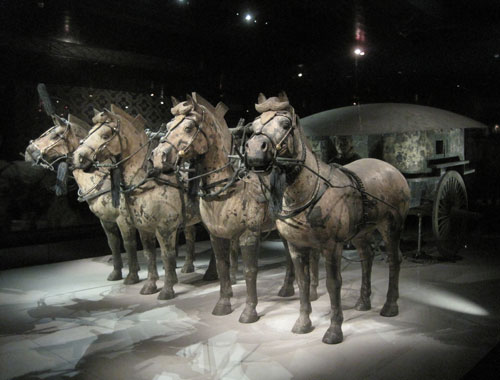
Chariot and horses are on display at the Terracotta Museum.[Photo:CRIENGLISH.com]
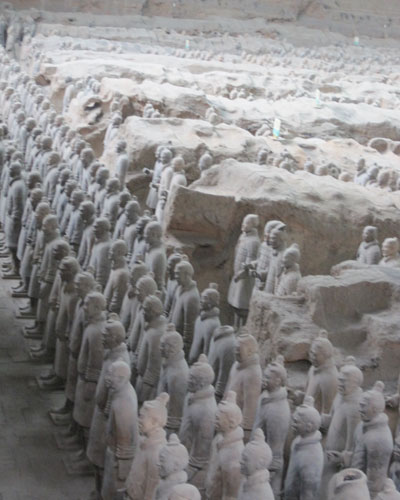
Thousands of terracotta soldiers, each with a unique face, line the largest pit.[Photo:CRIENGLISH.com] Emperor Qin defeated the other six warring states in ancient China, unifying China under his dynasty. He immediately set to work on improvements: standardizing currency, weights and measures; building parts of the Great Wall; and dedicating a massive labor force to building his own grave outside of Xi'an. His massive tomb complex took 40 years to complete, despite the fact that Emperor Qin only ruled for 37 years. His son continued to build the complex after his father's death. But, Emperor Qin's successor, who was placed on the throne in scandal, proved weak and the dynasty fell only a few years later. The grave site was discovered in 1976 by a local farmer, and you may be lucky enough to meet him on the days he comes to sign autographs. Visitors to the Terracotta Soldier Museum may easily be run over by eager tour groups, but the museum is truly one of China's treasures. Thousands of soldiers are on display, each with a unique face. Originally painted with bright colors, oxidation has unfortunately left most of the soldiers with clay-brown exteriors. However, a few soldiers with remnants of paint are on display in glass cases, where onlookers can admire the attention to detail given to each of the soldiers. Currently, three pits are open to the public, with two more set to open in the next few years, showcasing imperial concubines and chefs. Legendary poet Li Bai famously hung out in the busy West Market during the Tang Dynasty. Nowadays, the market is preserved as a museum. During Li Bai's lifetime, it was full of Silk Road merchants, where shopkeepers traded foreign treasures from the Silk Road and tavern owners even employed foreign women to add allure to their services. These taverns are said to have been a favorite spot for Li Bai as he fulfilled his famous love affair with wine. Some nights, he could be found on the floor of the market in such a stupor that it was said even the emperor could not wake him. His poems are considered the greatest in Chinese history and are still quoted by schoolchildren and the elderly alike. Li Bai met an equally poetic death, trying to embrace the moon in the Yangtze River. But, Chinese history is not without its female legends. Yang Guifei was the favorite consort of Emperor Xuanzong of the Tang Dynasty. Known as one of the four great beauties of ancient China, her love story eventually caused the downfall of the emperor. In an attempt to appease the Anshi Rebellion, Emperor Xuanzong had her killed. He never recovered from her death-- and despite her sacrifice, he still lost his throne. At the Hua Qing Hot Springs, you can see the luxurious bath built just for her, as well as the baths of the emperor and another for his official staff. The water from the hot springs at the foot of the Li Mountain has been revered by the Chinese throughout history for its healthy mineral content and constant temperature of 43 degrees Celsius, making it ideal for treating a variety of ailments. Visitors can even bathe their hands and faces in the famous water. For those more interested in power struggles than beautiful water, just up the hill is the cave involved in the Xi'an incident of 1936. In that small retreat, within sight of any visitor to the Hua Qing Springs today, Generalissimo Chiang Kai-shek was arrested by General Zhang Xueliang (nicknamed the "Young Marshal") and forced to go to war against the Japanese, who had invaded Manchuria. Travelers hoping to take a journey through some of the more dramatic moments of Chinese history will definitely satisfy their tastes in Xi'an. Less confident visitors seem to stay in tour groups, which are rampant in the city. But, as one visitor from Boston put it, "We wouldn't have missed Xi'an even if it was not on our tour!" Armed with a little bit of determination and some facts about Chinese history, step away from your tour guide and take your time exploring Xi'an's thrilling past. |
|
| Author锛? Angela Pruszenski 銆€銆€銆€Source锛? CRI 銆€銆€銆€ Editor锛? Wu Qiong | |