涓枃绠€浣?/a>銆€|銆€


| Behind the reality | |||
http://english.dbw.cn銆€銆€
2010-09-08 13:19:07
|
|||
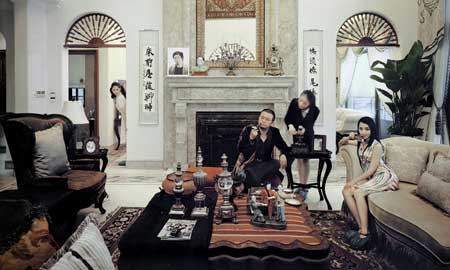
Luxury houses and beautiful women are often considered symbols of a wealthy and successful life that many men dream of, but in photographer Chen Jiagang's eyes those seemingly splendid things can also be poison, not only to the people themselves, but to society as a whole. In his newly released work Model Houses, currently on show at White Box Museum of Art in Beijing's 798 Art District, Chen presents a fierce irony of a rising social issue: the dream and false promises of owning real estate that exist in every aspect of many Chinese people's lives today and that is in effect forcing the exponential rise of real estate prices, making the supposed dream even more unattainable. Scheduled to run until October 4, Chen's solo exhibition Diao Yu Tai displays a series of his new works with the subject of the real estate industry. He set beautiful women posing in model houses that were meticulously decorated by real estate developers, showing their love, resentment and fear in the large, beautiful homes, as if they are playing in an avant-garde drama. However, through these seemingly splendid images Chen wants to reveal what he considers an urgent issue in Chinese society today: as real estate becomes one of the main industries in China, people are desperately racing to buy larger houses, which is actually harmful for healthy economic development. "Both luxury houses and women are seducing to all, but they can also be symbols of absurdity," Chen told the Global Times. "It is ridiculous that so many people are pursuing wealth at all costs, buying houses is just one aspect." Chen added that he is always trying to capture not beautiful or ugly scenes themselves, but "things behind them, happy or sad." In his eyes model houses equate to one of the most dangerous seductions in the world. "It attracts you to imagine a beautiful luxury house and lifestyle that real estate purports to offer. It is a dangerous way of promotion," he said. As once a successful real estate developer himself in the 1990s, photographer Chen has a unique sentimental perception on this particular issue. He said that although he only spent the past 18 months working on this series, he conceived the idea some 20 years ago. Graduating with a bachelor's degree in architecture, Chen began working as an architect at China Southwest Architectural Design and Research Institute and won several awards for his designs. He then owned real estate and interior design companies in the 1990s and was an enthusiastic art lover, often sponsoring artists who were his friends through buying some of their works. Consequently, Chen was among the first collectors to buy contemporary Chinese works. He even opened a contemporary art museum in 1997, the first non-government art museum dedicated to Chinese avant-garde art. Chen's company went bankrupt in 2001 and he turned to photography in search of peace in his heart, as he had loved taking pictures since his childhood. "Photography was my redemption at first, now it's all my life," Chen said. Chen began by taking photographs of remote countryside sceneries, but gradually became dissatisfied with what he saw and moved to explore what lay beyond the images themselves. |
|||
| Author锛? 銆€銆€銆€Source锛? xinhua 銆€銆€銆€ Editor锛? Yang Fan | |||