 涓枃绠€浣?/a>銆€|銆€


| External and Internal | |
http://english.dbw.cn銆€銆€
2009-11-17 09:51:55
|
|
|
The distinction between external and internal (澶栧唴) martial arts comes from Huang Zongxi's 1669 Epitaph for Wang Zhengnan.Stanley Henning proposes that the Epitaph's identification of the internal martial arts with the Taoism indigenous to China and its identification of the external martial arts with the foreign Buddhism of Shaolin鈥攁nd the Manchu Qing Dynasty to which Huang Zongxi was opposed鈥攎ay have been an act of political defiance rather than one of technical classification.Kennedy and Guo suggests that external and internal classifications only became popular during the Republican period. It was used to differentiate between two competing groups within The Central Guoshu Academy.Regardless of the origin of this classification scheme, the distinction becomes less meaningful since all complete Chinese martial art styles have external and internal components. This classification scheme is only a reminder of the initial emphasis of a particular style and should not be considered an absolute division. External stylesExternal style (澶栧; pinyin: w脿iji膩; literally "external family") are often associated with Chinese martial arts. They are characterized by fast and explosive movements and a focus on physical strength and agility. External styles includes both the traditional styles focusing on application and fighting, as well as the modern styles adapted for competition and exercise. Examples of external styles are Shaolinquan, with its direct explosive attacks and many Wushu forms that have spectacular aerial techniques. External styles begin with a training focus on muscular power, speed and application, and generally integrate their qigong aspects in advanced training, after their desired "hard" physical level has been reached. Most Chinese martial art styles are classified as external styles. Internal styles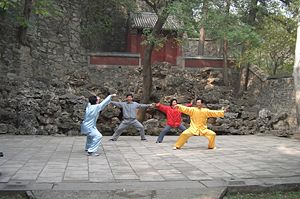
Taijiquan, the best-known internal style of Chinese martial arts, being practiced at the Fragrant Hills Park, Beijing
Main article: N猫iji膩
Internal styles (鍏у; pinyin: n猫iji膩; literally "internal family") focus on the practice of such elements as awareness of the spirit, mind, qi (breath, or energy flow) and the use of relaxed leverage rather than unrefined muscular tension, tension that soft stylists call "brute force".While the principles that distinguish internal styles from the external were described at least as early as the 18th century by Chang Nai-chou, the modern terms distinguishing external and internal styles were first recorded by Sun Lutang; who wrote that Taijiquan, Baguazhang, and Xingyiquan were internal arts. Later on, others began to include their style under this definition; for example, Liuhebafa, Zi Ran Men, and Yiquan. Components of internal training includes stance training (zhan zhuang), stretching and strengthening of muscles, as well as on empty hand and weapon forms which can contain quite demanding coordination from posture to posture. Many internal styles have basic two-person training, such as pushing hands. A prominent characteristic of internal styles is that the forms are generally performed at a slow pace. This is thought to improve coordination and balance by increasing the work load, and to require the student to pay minute attention to their whole body and its weight as they perform a technique. In some styles, for example in Chen style of Taijiquan, there are forms that include sudden outbursts of explosive movements. At an advanced level, and in actual fighting, internal styles are performed quickly, but the goal is to learn to involve the entire body in every motion, to stay relaxed, with deep, controlled breathing, and to coordinate the motions of the body and the breathing accurately according to the dictates of the forms while maintaining perfect balance. Internal styles have been associated in legend and in much popular fiction with the Taoist monasteries of Wudangshan in central China. |
|
| Author锛? 銆€銆€銆€Source锛? dbw.cn 銆€銆€銆€ Editor锛? Yang Fan | |


