|
The traditional dividing line between the northern and southern Chinese martial arts is the Yangtze River. A well known adage concerning Chinese martial arts is the term "Southern fists and Northern kicks" (銆屽崡鎷冲寳鑵裤€?. This saying emphases the difference between the two groups of Chinese martial arts. Although such differences are not absolute and there are many Northern styles that excel in hand techniques and conversely, there are many different type of kicks in some Southern styles. A style can also be more clearly classified according to regional landmarks, province, city and even to a specific village.
Northern styles
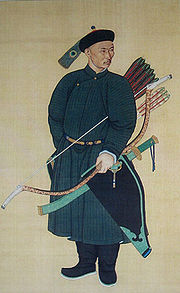
Manchu banner soldier, a caste of professional martial artists active in Chinese society as recently as a hundred years ago
Northern styles/B臎i p脿i (鍖楁淳) feature deeply extended postures 鈥?such as the horse, bow, drop, and dragon stances 鈥?connected by quick fluid transitions, able to quickly change the direction in which force is issued.
In general, the training characteristics of northern styles put more focus on legwork, kicking and acrobatics. Some say this is because the northern Chinese were generally taller than those living in southern China, and such training takes advantage of their greater range of motion, especially in their legs. Others claim that the terrain of northern China is more suitable to kicking techniques, or that the cold of the northern Chinese winter caused the practitioner to emphasize leg techniques rather than hand skills. Still others suggest that jump kicking techniques were developed to fight Mongolian horseman who used "very short stirrups". Regardless of the reason, Northern styles exhibit a distinctively different flavour from the martial arts practised in the South. The influence of Northern styles can be found in traditional Korean martial arts and their emphasis on high-level kicks.
The group of Northern martial arts includes many illustrious styles such as Baguazhang, Bajiquan, Ch膩qu谩n, Chuojiao, Eagle Claw, Northern Praying Mantis and Taijiquan. Ch谩ngqu谩n is often identified as the representative Northern style and forms a separate division in modern Wushu curriculum.
Southern styles
Main article: Nanquan
Southern Chinese martial arts (鍗楁淳) features low stable stances and short powerful movements that combines both attack and defense. In practice, Nan Quan focus more on the use of the arm and full body techniques rather than high kicks or acrobatic moves. There are various explanations for those characteristics. Some suggest that the physical stature of the Southern Chinese is responsible. The Southern Chinese are generally shorter in contrast to the Northern population and as a result the Southern styles are generally short, direct and powerful. Similarly, it is speculated that the dense urban population and its humid climate made focusing on close-quarter hand techniques more practical then the kicking techniques of the North. Still others suggest that the Southern styles focus on practical fighting techniques that can be mastered in a short time because Southern styles were founded and used by Chinese rebels.The influence of Southern styles can be found in Goju Ryu, a karate style from Okinawa.
The term Southern styles typically applies to the five family styles of Southern China: Choy Gar (钄″), Hung Ga (娲), Lau Gar (鍒樺), Li (Lee) Family (鏉庡) and Mok Gar (鑾). Other styles include:Choi Lei Fut, Fujian White Crane, Dog Style Kungfu, Five Ancestors, Wing Chun, Hakka, Southern Praying Mantis Bak Mei and Dragon. There are sub-divisions to Southern styles due to their similar characteristics and common heritage. For example, the Fujian and Hakka martial arts can be considered to be one such sub-division. This groups share the following characteristics that "during fights, pugilists of these systems prefer short steps and close fighting, with their arms placed close to the chest, their elbows lowered and kept close to the flanks to offer them protection".Nanquan (Southern Fist) became a separate and distinct component of the current Wushu training. It was designed to incorporate the key elements of each major Southern style.
Other geographical classifications
Chinese martial arts can also be identified by the regional landmarks, province, city or even village. Generally, this identification indicates the region of origin but could also describe the place where the style have established a reputation. Well known landmarks used to characterize Chinese martial arts include the famous mountains of China. The Eight Great Schools of Martial Arts (鍏ぇ闁€娲?, a grouping of martial arts schools used in many wuxia novels, is based on this type of geographical classifications. This group of schools include: Hua Shan (鑿北), 脡m茅i Sh膩n (宄ㄥ祴灞?, Wudang Shan (姝﹀綋灞?, Mt. Kongtong (宕嗗硳灞?, Kunlun Mountains (宕戝礄灞?,Cangshan (钂煎北), Mount Qingcheng (闈掑煄灞? and Mount Song Shaolin (宓╁北灏戞灄). Historically, there are 18 provinces (鐪?in China. Each province have their own styles of martial arts. For example, in Xingyi, there are currently three main branches: Shanxi, Hebei and Henan. Each branch have unique characteristics but they can all be traced to the original art developed by Li Luoneng and the Dai family. A particular style can also be identified by the city where the art was practised. For example, in the North, the cities of Beijing or Tianjin have created different martial arts branches for many styles. Similarly, in the South, the cities of Shanghai, Canton and Futshan all represented centers of martial arts development. Older martial art styles can be described by their village affiliation. For example, Zhaobao style tai chi (瓒欏牎蹇介潏鏋跺お妤垫嫵) is a branch of Chen Tai Chi originating from Zhaobao village.
|


