 涓枃绠€浣?/a>銆€|銆€


| Jinggang Mountain in Jiangxi | |
http://english.dbw.cn銆€銆€
2009-09-14 10:09:57
|
|
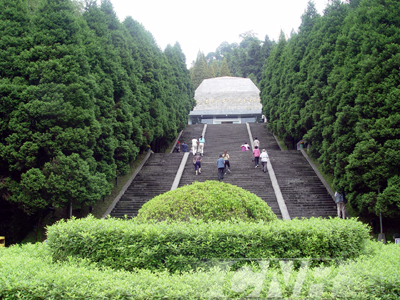 Huangyang Jie is one of the five famous sentries. The well-known Defence of Huangyang Jie happened here and Mao Zedong's poem-Xijiang Moon was written to commemorate it. The monument to the Defence of Huangyang Jie is made up of an upright stele and a transverse stele, on which are carved the inscriptions of Mao Zedong and Zhu De. The old residences of the Red Army leaders remain here and many stories about the revolutionary period have come down to us. A trench is also preserved and many tourists put on Red Army attire to be photographed near the trench as a souvenir. The Up-Well (Shangjing) Red Army Mint in Huangyang Jie played a very important role during the Chinese revolution and helped the revolution base to cover the hard period at that time and collected experiences for the other bases. Some of the old equipment is kept there as well as the tools and materials used to make currency. Some Silver dollars (Yinyuan) were unearthed when the mint was restored and in the Currency Museum you can see these coins that were minted by the Red Army. Ciping, the center of the Mt. Jinggang area and red revolution base of China, is the place where many sights can be seen. Ciping is a mountain city and was the location of the highest leading department of the Mt. Jinggang revolutionary base. Now many places of interest in connection with the revolution can be seen here. Among these are the Mt. Jinggang Revolution Museum, the Tower of the Revolutionary Martyrs and military statues. Mt. Jinggang Revolution Museum was established here in 1959. The museum uses modern techniques of sound, light and models to illustrate the important events of the revolution. The main natural beauties in this area are the Southern Mountain Park in south Ciping and the Yicui Garden. On the way to the mountaintop there are five kiosks. There is a pentagon exhibition hall on the mountaintop decorated with the statuary of workers, peasants and soldiers. Pen-Rack-Mountain (Mt. Bijia) is famed for the steep peaks, unique rocks, old pines, sea of clouds, sunrise and the 5 kilometers (about 3.1 miles) patch of rhododendrons-the flower of Mt. Jinggang City. The blooming rhododendrons here can be called a wonder, every March or April thronged people came here to take photos for the beautiful natural sight. Maoping is located in the north foot of Huangyang Jie with many revolutionary sites. Here we have Bajiao Lou (a two-story building), those who are familiar with Chinese history may recall that Mao Zedong lived, worked and finished two splendid revolutionary works here. The first hospital of the base was established in Panlong Shuyuan (a classical academy in ancient China) of Maoping. You can visit the treatment room, medicine room and see some of the equipment used at the time. Another site that provided support to the base is a bedclothes factory which mainly produced the army clothes, hats and bullets bags. Each of these sites made a contribution to the achievements of the Red Army. The famous Monument and Memorial to the Joining of Forces on Mt. Jinggang is situated in the Dragon-city (Longshi) area, southwest of Huangyang Jie. The monument commemorates the achievement of Mao Zedong and Zhu De. The five exhibition rooms present the important event in Chinese history to tourists. The monument is 19.28 meters (about 21.1 yards) high, 5 meters (about 5.5 yards) long and 4 meters (about 4.4 yards) wide which indicates the date of join forces-May 4th, 1928. The two sides of the monument are inlaid with red marble, symbolizing two oriflammes, depicting the successful meeting of the two forces on Mt. Jinggang. Mt. Jinggang has an indispensable place in Chinese revolutionary history and offers a good insight into the history of the Chinese revolution. However, this is not only a Red Army tourist spot but is also an area of natural beauty that offers you plenty of scope for relaxation. <<previous [1] [2]
|
|
| Author锛? 銆€銆€銆€Source锛? travelchinaguide.com 銆€銆€銆€ Editor锛? Wu Qiong | |


