|
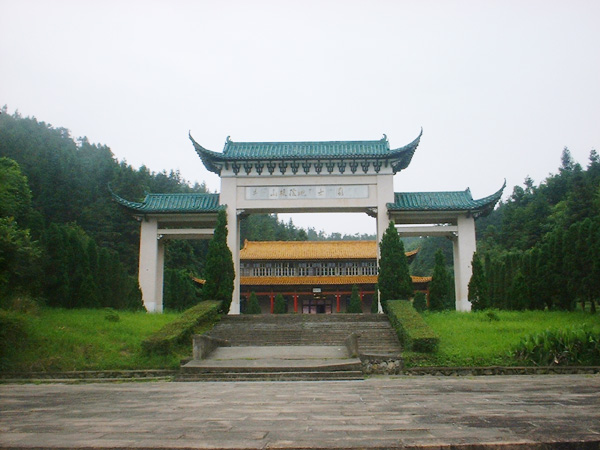
This mountain has great significance in the annals of modern Chinese history for it was here that important events during the Chinese revolution took place. For those who are interested in the history of the revolution, it is possible to take a tour on Mt. Jinggang that the people who against great odds struggled to establish the Peoples' Republic of China. Mt. Jinggang is famous for the fact that it was here that forces led by Zhu De joined those headed by Mao Zedong. Together, the combined forces of the CCP (Chinese Communist Party) marched on to a victory that was to establish the new China under the Chairmanship of Mao Zedong. Mt. Jinggang with its special features is quite different from the other sights, which makes a visit so rewarding.
Mt. Jinggang is located on the common boundary of Jiangxi Province and Hunan Province, 352 kilometers (about 219 miles) southwest from the capital city - Nanchang. The mountain areas have a high center that is surrounded by a somewhat lower level and between them they present two obvious steps. At the point that these steps are divided the relative height is 500 meters (about 1640 feet). It was here that the famous Five Sentries (the five Red Army military strongholds built) stood overlooking the difficult terrain. Another feature of the area is the many well-shaped basins among the ridges. It was these natural indentations that gave the mountain its name of Jing, meaning well and gang, meaning ridge - hence 'Jinggang'. Mt. Jinggang covers a fairly wide area but it is possible to arrange for a car to carry you to the various separate sites of interest. These are not far from each other and the cost, which can be negotiated, will be reasonable.
The first site of interest is Five-Fingers (Wuzhi) Peak; this is the highest in the Jinggang mountain range. The peak has the appearance of five extended fingers, hence its name. It is not only the highest point but is the largest and considered to be the most beautiful sight on the mountain. The steep peak extends in an imposing way from southeast to northwest. There is no path on which to climb and the unspoiled virgin forest on the mountain is almost without any trace of human beings, which means it remains the home of rare animal species including bobtail monkeys, sambars and the yellow-stomached tragopan. Hence it is a secret world even now. Tourists may climb up to the Sightseeing Platform opposite, which is the best view point for seeing its majestic appearance. The huge peaks confront each other on two sides to form a valley. The Mt. Jinggang River twists and turns as it races through this valley. On the mountainside, and visible from a long distance, is a large waterfall that appears like a thin silk veil hanging from the sky. The group of lakes at the foot of Five-Fingers (Wuzhi) Peak is like a bright moon shining upon the boundless sea of clouds. Five-Fingers Peak is now the nature reserve of Jiangxi Province.
The next site is the Dragon-Pond (Longtan) waterfalls also referred to as the Five-Dragon-Pond. When you enter this area long before you catch sight of the falls, you will hear the thunder-like roar of the water. Upper most is the Jade Waterfall that drops down to the green and limpid Jade Pond. The second is Lock-Dragon-Waterfall which spews out from the yellow cliff top into the Golden-Lock-Pond. The flow of water is not large but it is famed for what appears like a dragon trapped in it. The next are Pearl Waterfall and Pearl Pond. The waterfall rushes down from a 30 meter (about 99 feet) high cliff and is caught in its path by a large rock that causes the water to break into thousands of pearl-like droplets that glisten in the bright sunshine, hence its name. The forth are the Flying-Phoenix-Waterfall and Flying-Phoenix-Pond. At the bottom are the Maiden-Waterfall and Maiden-Pond. In addition to these spectacular falls there are unique peaks, rocks and an echo cliff to be found in the sightseeing area.
|
 涓枃绠€浣?/a>銆€|銆€


