涓枃绠€浣?/a>銆€|銆€


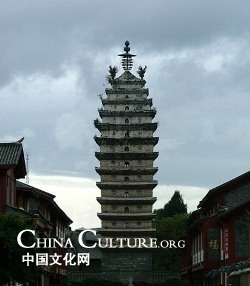
| The ancient pagoda in Yunnan | ||
http://english.dbw.cn銆€銆€
2009-01-05 09:45:37
|
||
|
The sculpture works on the pagoda are another enticing part, with the the lotus as the frequently used carving as a sign of national Buddhism cult tendencies. The number of floor levels of the square-eave-style pagoda is mostly odd, showing a long-time preference to the 鈥渙dd number concept鈥?of architecture among the Han nationalities. The square-eave-style pagoda is a religious art creation that combines Buddhism and Confucianism as well as Taoism and served as an influence of vital importance to the pagoda architecture in Dai and Bai nationalities in Yunnan province.
Pagoda styles in the Song dynasty were obviously inherited from the Tang dynasty, It wasn鈥檛 until the Yuan dynasty, when Buddhism enjoyed its golden age, the art of Buddhism evolved increasingly mature, galvanizing more and more aesthetic inspirations into Buddha statues and Buddhist architecture. After the Ming dynasty, with a mass of Han nationalities migrating to Yunnan, the pagoda not only served as a symbol of the Buddhist cult, but also as a lighthouse for spread and development the Han culture. The pious pray to the Buddha and even high official positions eagerly flooded into and ultimately incorporated the pagoda.
Apart from its Han-style pagodas, Yunnan boasts a miscellaneous set of pagodas with different national styles. For instance, the Da Yao white pagoda was built in Lamaist style, and is the earliest extant Tibetan-style pagoda in China, indicating the diversity of Buddhism of Yunnan during the Tang dynasty. Nurtured by the architectural style of Indian, Burmese, Thailand pagoda and the pagoda of the central plains of China, the Dai-style pagoda, mostly in circular form, emits more charm with its architectural form of sophistication. Among all the pagodas in Yunnan, Theravada pagoda expresses a kind of strong human touch and was considered by the disciples as a live thing with flesh and blood, just as a human. |
||
| Author锛? Hu Zhicheng 銆€銆€銆€Source锛? chinaculture.org 銆€銆€銆€ Editor锛? Wu Qiong | ||