涓枃绠€浣?/a>銆€|銆€


| The ancient pagoda in Yunnan | |||
http://english.dbw.cn銆€銆€
2009-01-05 09:45:37
|
|||
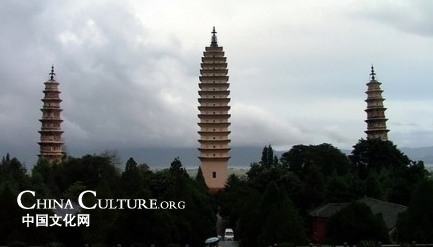
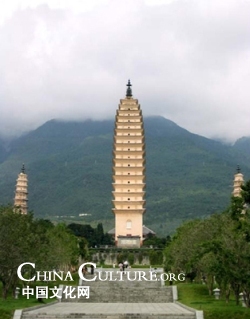
As an immemorial Chinese Buddhist architecture and a precious showcase of the cultural resources of Yunnan province, the pagoda gradually became an architecture form of historical interest with its unique artistic model, thus attracting throngs of Chinese and foreign visitors. Yunnan boasts amazing various forms of ancient pagodas brimming with obscurity of Buddhist religious cults and a touch of overflowing worldly emotions with a poetic flavor, giving visitors an edifying and aesthetic enjoyment. When Buddhism was brought to Yunnan province, China, the word 鈥淒u Po鈥?(the slope) spread to China as well. The word means 鈥渁ccumulation,鈥?an architectural form in ancient India used to bury skeletons. It is the original molding of the ancient pagoda.
Born of the 鈥淒u Po鈥?per se, the pagoda has still displays the disparate characteristics of nationalities after spreading to Yunnan .The most representative types of the Yunan ancient pagoda are the Chinese 鈥搒tyle pagoda, Dai-style pagoda and Tibetan-style pagoda, each influenced by Chinese Buddhism, Buddhism of Pali Language, and Lamaism respectively. Their mutually compatible features have fostered the Yunnan pagoda with a colorful diversity. After the Tang dynasty, a large amount of Yunnan pagodas emerged just at the times when Zen Buddhism became the typical Chinese Buddhism, and with the blending of Taoism and Confucianism. The architectural form of the pagoda at that time was deeply affected by the Chinese traditional pavilions, tower buildings and terraces and to some extent marked by the thoughts on aestheticism of Taoism and Confucianism with the square, hexagon and octagon as the basic shape. In the Han and Tang dynasties, the tomb was built in square shape as a sign of royal respect while the pagoda built in hexagon and octagon shape symbolized the 鈥淭he six paths of metempsychosis鈥?and eight Buddhism virtues respectively. |
|||
| Author锛? Hu Zhicheng 銆€銆€銆€Source锛? chinaculture.org 銆€銆€銆€ Editor锛? Wu Qiong | |||