 涓枃绠€浣?/a>銆€|銆€


| Profiting from a fresh outlook | |
http://english.dbw.cn銆€銆€
2012-10-11 08:55:18
|
|
|
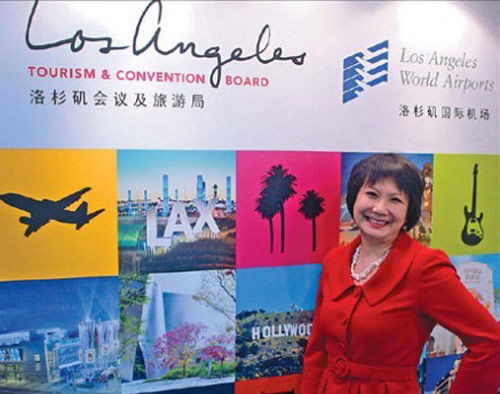 銆€銆€Jamie Lee, regional director of the Los Angeles Tourism & Convention Board's Beijing office. 銆€銆€Casual travel 銆€銆€Tina Yao, chief representative of Hawaii Tourism China in Shanghai, said her employees regularly attend exhibitions such as the annual China Wedding Expo and international tourism fairs in Shanghai and other cities. In doing so, the office publicizes Hawaii and its tourism, said Yao. 銆€銆€"Compared with business trips, this form of travel is casual and can help people interact. Once contact has been established, other business can be introduced," said Lee. 銆€銆€She said her office also functions as an economic exchange and cultural ambassador. In addition to promoting simple tourist packages, the LA Tourism & Convention Board has organized for 100 Beijing students to sing in LA schools as part of an exchange program. 銆€銆€Grace Pan, Tourism Queensland's international director for the Chinese mainland, Hong Kong and Taiwan, said promotion is hard work, although Chinese travelers are keenly aware of Queensland's tourist highlights, such as the Great Barrier Reef. 銆€銆€Previously, Chinese visitors heading to Queensland had to transfer in Singapore, no matter which airline they used. Pan realized that direct flights between China and Queensland were urgently needed. 銆€銆€Now, after six years of hard work, China Eastern Airlines will begin direct flights between Shanghai and Cairns on Oct 30. It's estimated that the new route will generate annual revenue of $35 million for Australia's "Sunshine State". 銆€銆€"It was a tough task to initiate the flight. We had to convince the airlines that there would be sufficient customer demand before they would take the risk. The local authorities in Queensland also had to support the route in terms of favorable policies, such as operational efficiency and taxation," said Pan. 銆€銆€"So we were like a broker between Shanghai and Queensland, trying to meet the demands of both parties." 銆€銆€The number of Chinese tourists to Queensland soared to 226,000 in March from 140,000 in 2006, making China the second-biggest source of overseas visitors to the state. 銆€銆€Pan and her colleagues are also devoted to attracting Chinese investors. Last year, Queensland's tourism minister, Jann Stuckey, held roundtable meetings with Chinese officials during an eight-day visit to four cities, including Beijing and Shanghai. Stuckey also introduced Chinese entrepreneurs to a number of investment projects in the state. 銆€銆€A window into China 銆€銆€Pennsylvania and China have many business links. In 1999, the US state's Department of Community and Economic Development opened a Beijing office, hiring Zou Zishu as its first chief representative, to promote products and services, including chemicals, iron and steel and coal. 銆€銆€All the employees are subject to performance-based evaluation, in another words, how much revenue they bring in for Pennsylvanian companies. In 1999, the office had to sell products or services worth $3.5 million. This year, the state requires Zou's office to generate sales worth $13.5 million. 銆€銆€Pennsylvania plays host to 29 multinational companies in the global top 500, including the fuel, services and design giant Westinghouse. However, the state government has stipulated that Zou's office should mainly work for small- and medium-sized enterprises. These companies account for 90 percent of the more than 1,000 companies Zou has served during his tenure. 銆€銆€Each year, Zou works for 87 Pennsylvania companies, 30 percent of which are newly established. "Large companies have the funds to set up branches if they believe in the potential of the Chinese market. By contrast, small companies hire us to explore the market, because they don't have to pay for a workplace or employees. The only thing we ask for is our commission," he said. 銆€銆€Many foreign companies undergo a period of acclimatization to the local environment when they first establish branches overseas. "If companies hire us, they don't have to worry about that, because our first task is look for opportunities with a thorough analysis and understanding of the market," said Zou. 銆€銆€Biased perceptions of China by many US entrepreneurs make Zou's job even harder. "In their minds, China doesn't respect intellectual property rights, and inventions will be copied the moment they are introduced. Thus, Chinese businessmen can't win trust from their US counterparts," he said, adding that many new companies neither dare step into China nor know how to run their business when they actually arrive. 銆€銆€In the United States, economic growth mainly relies on state governments, so companies from Pennsylvania are likely to heed my advice, said Zou. 銆€銆€"Therefore, we have to tell new, but small, companies how to operate in the Chinese market and how to sell their products," said Zou. 銆€銆€Zou, suggested that Pennsylvanian companies should target high-end customers and new technologies. In addition, the companies should export goods that China does not have. For example, China is the largest importer of Pennsylvanian hardwood, mainly for flooring. 銆€銆€Budget cuts 銆€銆€Unlike the relatively straightforward task of increasing tourist numbers, the promotion of trade and investment has become much more difficult in the wake of the global economic slowdown. 銆€銆€The 2008 financial crisis led to a budget cut of 60 percent for Zou's office. Prior to the meltdown, Zou was able to send his staff to many exhibitions, no expense spared. 銆€銆€Zou and his colleagues are now unable to travel outside Beijing because all business trips have to be approved by the state government. "Now we can only attend exhibitions in Beijing and we contact most of our clients by the phone." 銆€銆€Every month, the Council of American States in China meets the 31 chief representatives of state governments with offices in China to share information and coordinate their promotions. 銆€銆€"We often co-host events to alert people about our products and services," said Zou. "By doing so, we hope our businesses will grow more rapidly." <<previous [1] [2]
|
|
| Author锛? 銆€銆€銆€Source锛? China Daily 銆€銆€銆€ Editor锛? Wu Qiong | |


