|
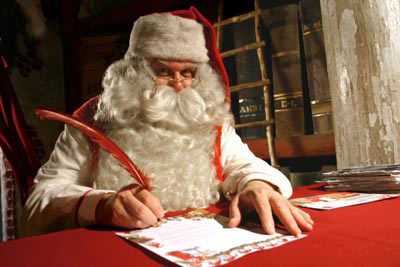
Traditional image of Santa checking his list. [Photo: sina.com]
He is particularly associated with children and gift giving and wears a long, red cape and a bishop's cap. Germanic folklore combined Saint Nicholas with the Norse god Odin, giving him the characteristic long white beard.
In England, Father Christmas or Sir Christmas was a man characterized by his Christmas cheer and first appeared in pre-renaissance era carols, but unlike Saint Nicholas, he was not associated with gift giving.
Early writings at the beginning of the 16th century describe Father Christmas, also sporting a long beard, with long stockings with a green fur-lined coat. He was believed to live in the ice and snow in the Lapland Province of Finland.
However, it was the Dutch idea of Sinterklaas that was brought to America in the 1700s that many attribute with the image of Santa Claus today.
In America, beginning in the 1700s, the Dutch and British colonials' combined versions of Sinterklaas and Father Christmas created Santa Claus. Over the years, through poetry and literature, Santa gained a considerable amount of weight as well as his famous reindeer and an ability to fly.
The famous poem, "Night before Christmas" by Clement Clarke Moore, as well as stories by other authors like L. Frank Baum and Thomas Nast concreted an image of a Santa with reindeer, elves and a wife at the North Pole.
During the year, the tale specifies that Santa stays at his workshop with his little elves making toys to deliver on Christmas Eve to all the good children of the world.
Needless to say, some hint that it was actually Coca Cola who had the last say in terms of creating the modern Santa. Red and white are Coca cola's famous trademark colors so it may have been through their advertising during the 1930s that finally solidified Santa's garb.
As for Santa's behavior, the omniscient Santa Claus who knows who's "naughty or nice" and punishes misbehavers is actually centuries old, and rooted in the old and oddly morbid Dutch myth of Sinterklaas's little helper who comes down the chimney and takes especially wretched children, puts them in sacks and takes them away.
Santa's famous list of names he can add or cross off comes either with the reward of presents or the less drastic threat of a lump of coal in kids' stockings. This habit is also derived from the Dutch Sinterklaas's helpers who later became what people today call Santa's little elves.
Modern Santa in America can be seen everywhere, from the local mall to Salvation Army charity collection stands and even Macy's Thanksgiving Day Parade. People tend to applaud or lament that this is the typical, yet more commercial version that is brought to China.
Some argue that the American Santa in China is a positive symbol of a century old figure who has become a holiday reminder to be generous and give as well as to always be on good behavior, while others perceive it as a sterile, cultural import.
Whether it's a motivator for children to behave or a new integration of western culture, many Chinese, especially children, have warmed to the idea of a round, gift giving American Santa whose cheery disposition and furry red hat has warmed the hearts of the children in China.
One thing is for sure, modern day Christmas with its tree, Santa, hats and all, has met modern day China in the metropolitan cities.
As the song notes, and seeing how Beijing has embraced the Christmas season and added it to its own holiday list, "Santa Claus is definitely coming to town," and from the looks of it, he may be here to stay.
|
 涓枃绠€浣?/a>銆€|銆€