|
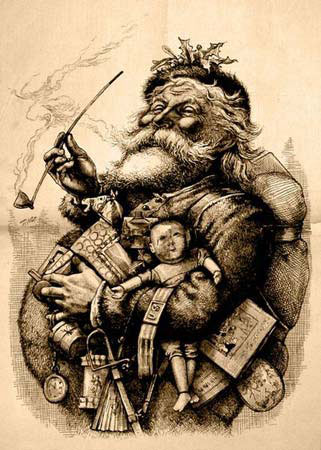
1881 illustration by Thomas Nast who, with Clement Clarke Moore, helped to create the modern image of Santa Claus. [Photo: sina.com]
This time of year, many westerners, perhaps Americans more so, are familiar with the popular tune in many a store, "Here comes Santa Claus, right down Santa Claus Lane鈥? Santa visits children all over the world on Christmas Eve, and more recently, has also added some Chinese children to his list. But where did he come from anyway?
Many western children grow up with the mystical notion of the jolly, old, bearded, fat man who defies physics and plunges down the chimney with a sack full of toys, eats cookies left by the tree and merrily leaves presents.
Chinese people are now familiar with Santa Claus faces and Christmas trees in restaurants and huge, 'twinkly' and impressive Christmas trees in the plazas by Shanghai's Jingan Temple or in front of Beijing's famous Workers' Stadium, but the actual history behind Santa Claus is one that remains relatively unknown here in China and admittedly to many westerners as well.
In the West, Santa Claus is more than just a symbol for many kids. Millions of western children grow up with the idea that there is a man who watches over them the entire year, noting every mischievous deed or unruly tantrum and could at any moment cross their scribbled name off his famous list.
Every child knows severity of this seemingly menial act because Santa's list decides the fate of their stocking content: presents for good behavior, a lump of coal for bad.
In order to assure good rapport with Santa Claus, children take the time to write letters to Santa, some speculate that hundreds of thousands of letters are received every year from 150 countries, to ask for gifts or their hopes.
On the actual evening of Santa's arrival, traditionally, many offer milk and cookies as a possible incentive for Santa to be more gracious.
So where did this idea of a jolly old fat man bringing toys down the chimney originate and how do you explain him to someone unfamiliar?
The idea for the man called Kris Kringle from the German Christkindl, Father Christmas, Saint Nick, or just plain Santa Claus may be a bit difficult to explain to children in China, where chimneys are hardly common and the idea of a fat, white and hairy man dressed in red who flies through the sky in a reindeer sled may seem a bit odd.
The actual history of Santa Claus is truly dizzying and encircles so many cultures and regional folklore and fables that have developed over centuries, beginning in Europe and flourishing into the rosy-cheeked, fat man who comes down the chimney.
What some people don't realize is that the idea of Santa Claus in America evolved from the European tradition a bit and branched in its own direction.
The concept of Santa Claus as some think of him today is a far cry from how he started out. Conflicting histories originate with the idea either of a robed, secret gift giver named Saint Nicholas or the Eastern Roman Empire or Greek persona named Basil of Caesarea. Both were credited as altruistic men who cared for the poor and underprivileged with an unmatched generosity.
Saint Nicholas was a real man who lived during in the 2nd century AD in what is now present day Turkey. He was a wealthy man who was known for his benevolence and later made a saint.
Most famously, conflicting stories of his generosity cycle around a tale of three Italian daughters.
One story goes that a poor man did not have enough money for his daughters' wedding day. The three girls hung up their stockings by the fireplace to dry, and Saint Nicholas deposited golden coins inside the daughters' stocking which they had left drying by the fireplace.
Another story suggests that the coins were either thrown through the window or down the chimney for the girls' dowries and in turn, saved them from slavery.
Every saint is honored on a day in the calendar, and in Holland, Saint Nicholas's, or Sint Nikolaas that eventually shortened to "Sinterklaas," has his specially remembered day on December 5.
|
 涓枃绠€浣?/a>銆€|銆€