涓枃绠€浣?/a>銆€|銆€


| Traditional Troupe Finds Way to Make Profit | ||
http://english.dbw.cn銆€銆€
2009-10-26 09:52:56
|
||
|
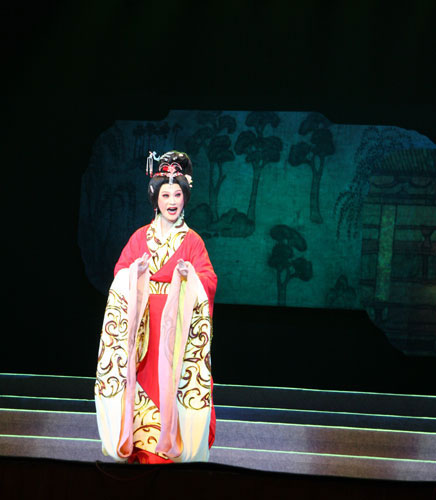
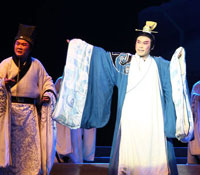
As the annual Shanghai International Arts Festival moves into its eleventh year, more and more Chinese traditional troupes are making their debuts at the festival in a bid to get exposure to wider audiences. Hebei's Shijiazhuang Si Xian Opera Troupe, which staged their new production "Song of Red Bean" for two nights, is one of these traditional art groups seeking commercial profit despite government funding. Traditional Troupe Finds Way to Make Profit Taken under the government's supervision in 1947, the troupe was revived after China's war-torn period of the early 1940s. The art was accepted again in Hebei and neighboring areas. There are quite a number of Si Xian opera fans among the older generation, said Wang Jianzong, Director-general of Shijiazhuang Si Xian Opera Troupe. But traditional opera has lost its appeal among young people. Challenged by pop culture and the emergence of the commercial art market, traditional troupes have to change with the times. Shijiazhuang Si Xian Opera Troupe initially tried to attract new audiences by creating original play books, instead of performing old-fashioned dramas time after time. Taking in a lot of contemporary elements, the troupe has produced several modern projects. "We didn't make a profit at the beginning, but with more and more toured performances, considerable money began to roll in, we are glad to see our innovation efforts finally pay," the director added. "Though the number of audience is not very big and the ticket price is much lower than mainstream commercial performances, we managed to make a profit with ticket sales. For instance in Hebei, we can make an average net profit of 5,000 yuan from each session during the high-season from January to May, so I'm optimistic about this means," Wang expressed his confidence in the new ways of running the troupe. "Song of Red Bean" is the troupe's latest historical drama, a hot genre among opera-goers in recent years. And the project in Shanghai is an updated version in collaboration with Shanghai-based top opera directors and stage designers. Asked about his comment on their first visit to Shanghai, Wang Jianzong replied, "I think our first-ever showup in Shanghai is successful thanks to the audience's positive feedback. I'm very happy with it." About Si Xian Opera "Song of Red Bean" The new Si Xian opera "Song of Red Bean" is based on both historical facts and folktales of the early Three Kingdoms period (220-280 AD), a time when China was split into three warring feudal states, Wei, Shu and Wu. The storyline centers around Zhen Luo, the devoted and loving wife of Cao Pi, first emperor of the Wei kingdom. Zhen Luo risks her life to save her brother-in-law Cao Zhi after overhearing that her husband, seeing Cao Zhi as a political enemy, is plotting to kill him in a routine court meeting. Cao Zhi, struck by the conspiracy, is then becoming pessimistic with life. Cherishing his outstanding talent in poetry, Zhen Luo tries to encourage her brother-in-law to recover up himself. The selfless woman gives up her queen's title in exchange for Cao Zhi to make a name with his literary talent. Cao Pi is so angered over Zhen Luo's renouncement that he issues an order that Zhen kill herself with poisonous liquor. |
||
| Author锛? Ma Ting 銆€銆€銆€Source锛? CRIENGLISH.com 銆€銆€銆€ Editor锛? Wu Qiong | ||