|
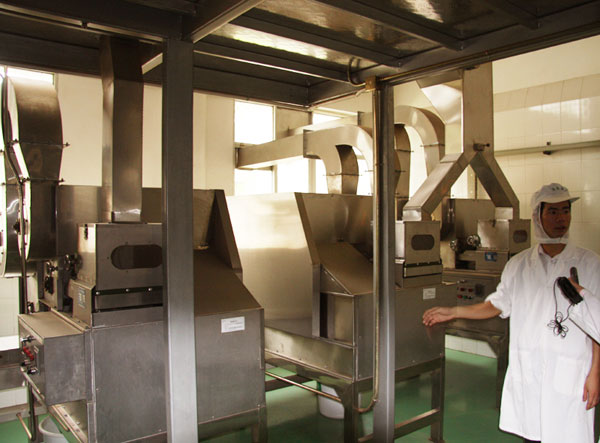
Su Jiancai, an employee of Eight Horses Tea Co., a tea manufacturer in Anxi, Fujian Province, introduces the company's automatic processing line on August 28, 2009. [Photo: CRIENGLISH.com]
Have you ever gazed into your cup while sipping on tea and wondered where the leaves came from? For a mystical but vague answer, you could turn to a tea-leaves reader. But for a precise history of how your tea leaves got from tree to cup, you may have to pin your hopes on newly-developed traceability systems.
Fujian Province's Anxi County, the southeastern Chinese home of the famous Tie Guan Yin tea, is encouraging local manufacturers to set up traceability systems that will make it possible for customers to know where and when a specific package of tea leaves were picked and how they were processed.
Tea traceability will not only make processing transparent, but also help manufacturers improve their products, according to Xu Qiuyan, a representative of Eight Horses Tea Co., a pilot tea traceability enterprise in Anxi.
"If a problem is reported, it's easy to identify the cause by tracing the process chain," says Xu. "Our traceability system helps us identify problems, avoid similar problems and thus improve our tea's quality."
Eight Horses, which was founded in 1993 by Wang Wenli, an inheritor of Tie Guan Yin craftsmanship, began to construct its traceability network in 2002.
Employees at every point on its process chain, from farms to factories, are required to keep detailed records of their work. These records are then archived into a database that can be accessed via terminals.
Over the years, Eight Horses has grown into the largest Tie Guan Yin manufacturer in Anxi. Its annual export exceeds 2,000 tons, accounting for 70 percent of Anxi's total exports. The company receives regular orders from Japan, Thailand, Russia, Australia, the United States and Europe.
Lin Rongxi, vice-general manager of Eight Horses, attributes the company's success to its efforts in traceability. "It would barely be possible for Eight Horses to have such a large export amount without our traceability system," he said.
Tracing Eight Horses' process chain uncovers a standardized manufacturing line. Every year, the company updates its list of recommended fertilizers and prohibited pesticides. "We will then send special teams to the farms to supervise farmers fertilizing their tea trees," says Zhou Zhuoneng, a manager at Eight Horses. The special teams will also document the fertilizing process and encourage farmers to keep records of their farming work, Zhou said. Contracted farmers are invited to training sessions where they are taught how to prevent and deal with pests.
During the picking season, the teams carry out strict safety checks of the leaves, and those failing to pass the checks are taken off the production line, according to Zhou.
Unlike traditional Tie Guan Yin workshops, Eight Horses boasts a highly automatic processing line. Workers entering its factories have to put on special clothes and get sterilized. All movements on the processing line are also documented for traceability.
As more Tie Guan Yin manufacturers in Anxi are adopting standardized processes and completing their own traceability systems, those of us with special concerns about food safety will be able to relish our tea worry-free.
|
 涓枃绠€浣?/a>銆€|銆€


