|
The global economic crisis seems to somehow undermine the importance of China's self-employed but unregistered street vendors, even though they comprise a large number of people laid off because of the slump.
For many low-income earners in China's big cities, roadside business has become the last means to earn a living. Therefore, it's time city authorities change their idea of urban management from banning street vendors to actually helping them earn a living respectfully. As a starter, local governments can grant low-income urban residents more living space and job opportunities.
This is where Western cities' experiences can come in handy. Unlike Chinese cities, many of the Western cities I have visited promote their special and usual fairs with street vendors and roadside restaurants as tourist attractions. People there are proud of maintaining such cultural heritages. Since the global economic crisis has compelled the government to shift its emphasis from export-oriented growth, promoting the service industry and the self-employed, including street vendors, is a potent way to boost the domestic market for economic development.
In today's China, roadside eateries and street vendors or hawkers are hardly seen as tourist attractions or a continuation of cultural heritage. Worse still, roadside eateries and vendors in China are seen as a nuisance and are usually blamed for the mess and disorder in urban areas. Hence, the authorities in Chinese cities prefer to ban them from vending or hawking their wares on pavements along important roads.
That certainly is not the way to treat people who don't need government help to solve the unemployment problem. But is promoting low-income earners to vend their wares on streets synonymous with promoting the service industry?
Some people think that developing the service industry is equal to pushing forward modern service sectors such as finance, trade and real estate. These sectors may contribute a lot to the GDP, but today they are not in a position to create enough jobs to solve the unemployment problem.
On the contrary, the unorganized consumer service sector, as opposed to the modern and organized service sector, has been a reliable source of jobs for low-income workers. And this sector is what we should pin our hopes on.
In the country's most developed cities, all of which have entered the post-industrial age, people, especially those who already own houses and cars, are demanding more and more from the service sector.
On the other hand, though computers have driven out many workers from their jobs in the cities, jobs like babysitters and restaurant hosts are still irreplaceable.
The middle class and low-income earners may be moving to suburbs because of skyrocketing housing prices. But high-income earners can still bear the high expenses of living in downtown areas and they are the ones who demand more services. As a result, consumer services are concentrated mainly in downtown areas.
Since it's expensive and inconvenient both for workers employed in the service sector to commute between their homes in low-cost but distant suburbs and their workplaces in downtown areas, they find it cheaper to rent a room in cheaper urban areas and share it with their fellow workers in the service and other sectors. This has given rise to survival-level neighborhoods in many cities.
This, in turn, makes it important for the cities' authorities to grant some, if not equal, consideration to the development of such neighborhoods. City authorities have to tolerate the widening income gap and offer subsidies and convenient public services to the low-income earners.
For example, local governments should allot some funds for the construction of low-rent houses in their urban management budget and reserve certain areas for the low-income earners to live. This will create a mutually beneficial situation for low-income earners and the well-off section of society both because the former can afford to live close to their workplaces and the latter can enjoy consumer services more conveniently and at a cheaper price.
If Western cities project their street vendors and roadside restaurants as tourist attractions, why do we keep blaming them for the mess and disorder, and banning them from carrying on their business?
City authorities have to change their idea of planning and urban management because without a radical change in city planning and management, any talk of creating more jobs and maintaining growth would be meaningless.
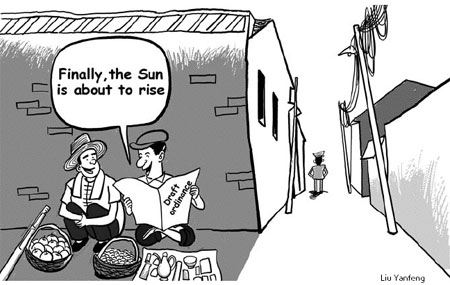
That's why the draft Ordinance on Individual Industrial and Commercial Households is a positive step toward changing our attitude toward urban management. Issued by the State Council Legislative Affairs Office to seek public opinion, the draft ordinance may grant street vendors legal status for the first time.
Beijing has already started pilot projects to allow street vendors to carry on their trade in designated places and at given times. Let's hope Beijing's pilot projects become a permanent feature in all Chinese cities.
The author is professor of economics in Fudan University.
|


