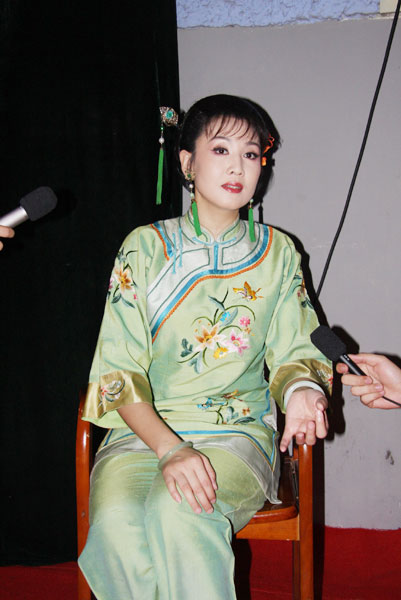
It was a big surprise when we arrived at the Anqing Zaifen Huangmei Opera Art Theatre Saturday afternoon to interview its president, only to find the prominent artist on stage, with makeup and costume, performing her best known production "Huizhou Women". She was in the course of shooting a ten-episode tribute documentary on Huangmei opera that is to be televised on Chinese Central Television (CCTV) during the upcoming Fifth China Huangmei Opera Art Festival this October in Anqing city.
"You can only achieve the ultimate performance when you are totally mad about opera." This quote from Leslie Cheung's Peking opera epic "Farewell, My Concubine" applies to Huangmei opera artist Han Zaifeng, a woman who thinks about Huangmei opera every minute, rediscovers its charm every time she reprises a role and promotes it to everyone she meets.
This is Han Zaifen, a prominent artist so enthralled by Huangmei opera that she has, for decades, championed the traditional art form.
Han lives and works for Huangmei opera, which has become a major part of her life.
Han Zaifen, now in her 40s, is president of the Anqing Zaifen Huangmei Opera Art Theatre. She is not only a top performer but also a talented manager who manages to juggle a 30-member Zaifen Huangmei opera troupe, play production and marketing campaigns.
"Leading the youth in the troupe, creating new products and promoting works to the outer market... handling all the things on your own brings you under great pressure and you can hardly rest. Now when asked what I usually do in my spare time, I cannot think of anything but the opera."
Born in Qianshan county, Anhui province, Han Zaifen left for a local Huangmei opera troupe in nearby Anqing at the age of ten. She made her first appearance on the small screen in "Zheng Xiaojiao" at 16 and rose to stardom after a slew of attractive roles in "The Emperor's Female Son-in-law" and "The Cowherd and the Girl Weaver" amongst others, during the 1980s when Huangmei opera was the vogue.
Huangmei opera is a major Chinese local opera, popular in Anhui province, which dates back some 200 years. Originally known as "Huangmei Melody" or "Tea-Picking Opera", the opera is evolved from Huangmei tea-picking based folk songs and dances.
In China, the 90s was a hard time for folk art, as pop culture gradually caught on and Chinese people, especially the young, diverted their focus to the fashionable and modern, leaving traditional opera in the cold.
Over the years, Han Zaifen always emphasized that Huangmei opera needed innovation while making it better fit into present-day life.
"We need to innovate every aspect of art form in general to aesthetic values other than sheer changes of the aria. The inner core and spirit of the art form, like its fresh and natural style, such as fundamental things passed down, of course, should not be dropped away. We also have to take into account people's aesthetic values today."
Therefore, the artist took the plunge to make changes before the debut of "Huizhou Women" in 1999, which proved to be a hit. This success elevated Han Zaifen to a higher level in her artistic pursuits.
"I should say, "Huizhou Women", ten years ago, was a considerable breakthrough in the reform of Huangmei opera and it was widely acclaimed. The art form was changed and Huangmei opera was raised to a higher level, in terms of music, stage design and prior public campaign, which was a rare thing for opera before."
The movement in "Huizhou Women" is also innovative. The heroine wears short-sleeved clothing so as to allow more dramatic and visible movements on stage rather than shuixiu, a kind of sleeve that can be meters long, whose movement tells different emotion in opera.
Han says, "Plays were usually based on classic stories and we are now trying to pick up subjects closer to everyday life. Why did we start performing modern and contemporary plays? We also hoped it would appeal to the young. I think art must be kept in line with the times."
The artist thinks Huangmei opera should be a leading avant-garde form of art in its content. She believes the changes in form come with the changes in content.
Han Zaifen is seen on stage, in TV series and film. Some may doubt her boundary-crossing performance, but the artist takes it as a good way of learning.
"I think that is precious experience for me, which enriches my expression on the stage of Huangmei opera. And now I am very clear of how to negotiate different forms of acting for TV, opera or film."
"After you come into contact with these performances, you learn that can also be used for opera. I am now inclined to blend things together and try to innovate. Cultural industry is also innovative industry, and that is really intriguing."
"We actually always do the same thing. Once you have a new play, you do it every day, but personally, I never feel it the same, though it looks the same. The inner feeling never repeats."
"Huizhou women" integrated new elements from stage drama, dance and painting. Exquisite stage design and even cinematography are employed to create enchanting effects.
It is more like a customized work for Han Zaifen that allows her the freedom to perform exactly the way she wants. Her intuitive voice and her fresh and unaffected performance fascinate her audience.
In the play, Han Zaifen embodies the endurance and persistence of a diligent and kind Huizou woman of the past, while the charm radiated from this beautiful and talented Huizhou woman is no less away from the stage.
Rather than moving away and seeking development in bigger cities like Beijing or Shanghai, Han Zaifen is rooted in Anqing, the hometown of Huangmei opera and takes good care of her troupe the way a mother nurtures a child.
She says she wouldn't leave Anqing, the cradle of several noted Huangmei opera artists. She believes Anqing sustains the special circumstances and cultural ambience for the promising folk art to grow and develop.
She joined the troupe in 1978 as a teenager and was mentored by professional predecessors who developed during a time of cultural renaissance. Han still feels appreciative of the efforts made by previous generations and the expectations they have for her. The full-fledged artist now takes the time to return and reward.
"Someone used to say to me that now you have grown up into a big tree that can give shelter from rain and wind, you have to take care of others," she smiles, "this is just the circle of life, simple but meaningful".
The opera artist doesn't like life in the big cities. She says that she doesn't desire too much from life, while living here in Anqing keeps her much closer to Huangmei opera, which is always fresh and always natural.
 涓枃绠€浣?/a>銆€|銆€