涓枃绠€浣?/a>銆€|銆€


| Hui-style Carvings Need More Attention from the Young | |
http://english.dbw.cn銆€銆€
2009-08-01 22:22:49
|
|
|
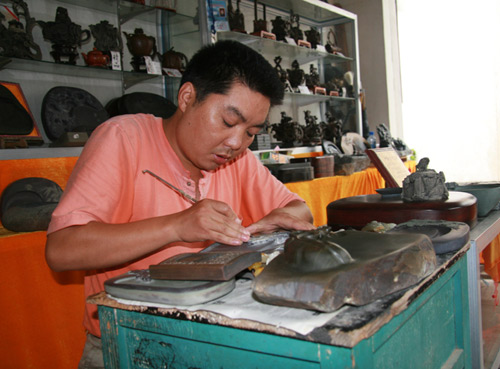
Yu Guoqing, a stone carver, works on an ink slab in Hongcun Village in East China's Anhui province on July 28, 2009. [Photo: CRIENGLISH.com] Among a wide variety of specialties in Hongcun Village, objects like wood, stone and bamboo carvings are most prominent. Some of the current artisans of these handmade souvenirs are former farmers-turned businesspeople. A boom in tourism in this village, in East China's Anhui Province, has helped establish it as a centre of ancient Hui culture. 37-year-old Yu Guoqing is an artisan who has set up a shop in the village. Unlike some others Yu is not a craftsperson bound to traditional taste and skills. He usually combines Chinese and western painting styles to develop his various designs. His systematic carving style and basic training in painting was instilled in him when he was very young. "Stone carving requires a lot of the carver, such as a strong sense of art. He, or she, must conceive a picture in their mind and decide how to alter the stone according to its structure and shape," Yu explained. "In this way, every self-made ink slab will be unique." Sometimes, Yu spends seven to eight days just imagining a design before even picking up his tools, which obviously takes much more time than those ink slabs produced in batches by machines. Yu remains confident that his artwork will not go out of date or decrease in popularity. "The machine-produced ink slabs appear the same and do not sell well here. They are usually sent to the stationers." He further explained that carving is not easy work. "It takes a lot of strength and usually makes your hands tired and your eyes hurt, as you need to stare at a stone the whole day." Therefore, few young people are willing to engage in carving nowadays, to say nothing of its relatively low profits. Chen Shuangxi, a bamboo carver in the village, voiced the same concerns, saying his eyesight and back had become weak since he and his wife established a bamboo carving business two years ago. The carving materials (wood, stone, brick, bamboo) and carving styles in Huizhou, originated during the Song Dynasty (960-1279) and reached their peak during the Ming (1368-1644) and Qing (1644-1911) dynasties. As an important part of local Hui culture, this style of carving has attracted more attention from local government. Huang Chunwei, a senior official in charge of tourism in the town of Hongcun, believes more capital will flow on from protecting such an intangible culture heritage. |
|
| Author锛? Liu Donghui 銆€銆€銆€Source锛? CRIENGLISH.com 銆€銆€銆€ Editor锛? Wu Qiong | |