涓枃绠€浣?/a>銆€|銆€


| Life of Tea Farmers | |
http://english.dbw.cn銆€銆€
2009-07-31 09:01:22
|
|
|
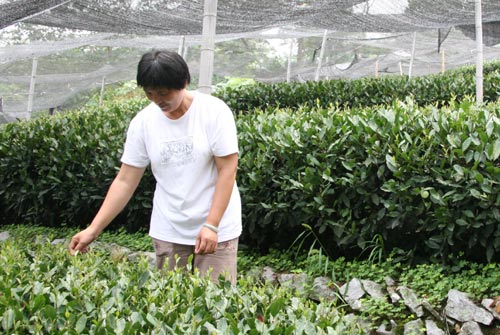
Bao Linhong, a 42-year-old tea farmer, shows how to pick tea leaves in her family's tea garden in Wengjiashan village in Hangzhou on July 26, 2009. [Photo: CRIENGLISH.com] Longjing tea, or Dragon Well tea, has enjoyed longlasting fame around the world for its unique fragrance and flavor. Bao Linhong, a 42-year-old tea farmer, showed us around the village and described the life of the residents. All of them are tea farmers who have produced Longjing tea for several generations. Every year in late March, the farmers begin harvesting tea. The long process lasts through October, with a total of 20-30 pickings from the same plants at intervals of seven to 10 days. But the quality of the tea deteriorates as time passes. Bao says the best Longjing tea leaves are harvested several days before the Qingming (Pure Brightness) Festival, which usually falls on April 4 or 5 when new twigs have just begun to grow. In the old days, Dragon Well tea of this grade was meant solely for the imperial households and therefore was known as "tribute tea". During the busiest picking time from March to April, laborers are employed from nearby provinces to help gather the tea leaves for some 20 days. "We don't have enough laborers in our family for tea-picking, but we must get them for the spring tea season," Bao said. The farmers and the workers have long-term relationships based on their years of working together. Each worker can earn 50 yuan, or about $7.30, a day. Local farmers offer workers three meals a day and accommodations in their houses. The employers also pay the workers' travel fees. After being picked, the new leaves must be aired and then parched in tea cauldrons. The parching is conducted three times with the first done by machine and the second and third done by hand. The tea cauldrons, which used to be heated by firewood, are now heated electrically to protect the environment. A tea-parching competition is held every year in April after the first tea harvest. Skillful tea-parching masters carry their own cauldrons and stir-parch by hand. When the parching is finished, the tea is sipped and evaluated immediately. The person who made the best tea will be crowned as the "tea-parching king," and his tea usually commands a high price. The finished tea products are sold mainly in three ways, Bao said. The government buys tea form the first harvest, while visitors purchase some of the rest part. But most of the tea is sold through long-term sales networks that the farmers have set up through relatives and friends. But the income from growing and selling tea is not enough to maintain a family, Bao said. "We need to do some part-time work outside to earn more money," she said. "People my age usually work as restaurant assistants and cleaners." Although the production of tea still mainly depends on the climate, tea farmers now enjoy much happier lives than before. Thanks to the roads connecting the village and the downtown, they conveniently can buy what they need within a 45-minute drive. When the villagers are not busy, they always visit their neighbors and chat with each other. Among the backdrop of their endless tea garden, the farmers eat outside amid the fragrance of tea and twittering birds and enjoy their leisure time in this unpolluted mountain area. |
|
| Author锛? 銆€銆€銆€Source锛? CRIENGLISH.com 銆€銆€銆€ Editor锛? Wu Qiong | |