涓枃绠€浣?/a>銆€|銆€


| Artist Turns His Back on Profit and Materialism | |
http://english.dbw.cn銆€銆€
2009-06-19 10:37:08
|
|
|
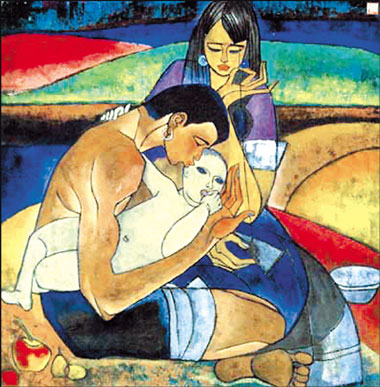
Naruo's paintings depict scenes of his home and people based on the Naxi pictographs. Almost 40 years after leaving his home in ancient Dayan Town in southwestern China's Yunnan Province, Wang Rongchang, 61, still speaks heavily accented Mandarin. The dark-skinned artist speaks little English despite living for 12 years in the United States. To his foreign friends, he is better known by his Naxi name, Naruo. Under this name, he has created a language all of his own, painting vividly colored scenes of his home and people based on the unique Naxi pictographs. The only pictographic writing system still in use, these detailed drawings describe the lives of generations of the Naxi people, whose kingdom survived in what is now southwest China from the 8th century AD till 1274. His paintings have been exhibited around the world, but Naruo has disdained fame and fortune, saying the purpose of his creativity is to sustain the culture of his people in a rapidly modernizing world. Since his retiring as an art teacher at Beijing's Minzu University in 2008, Naruo's major works have been based on more than 200 figure drawings, which he drew 30 years ago in the village of Dayan. All his figures wear traditional Naxi clothes, their faces are tranquil: a shy young girl sits near a hen roost, an old lady spins and a young man shoulders a hoe. Many of the traditions depicted have disappeared and many young Naxi people no longer speak the language or wear the traditional clothes, Naruo said. Naruo believes few artists now have the patience to spend the time drawing ordinary people. "I drew the people after living with them for two months, so I had enough time to watch and understand them." He plans to keep the paintings for himself: "I don't want to change them for money. I am not painting them for business." He says modern society is undergoing a chaotic materialization, and many people have lost their innate sense of morality and basic principles. However, everyone needs the support of their national culture, he says. "They will realize the sorrow in their hearts one day and return to the original national culture." And Naruo believes this will be the appropriate time to display his work. "I'll let the world see my paintings when everybody feels a void in their spiritual life and in need of real art," he says. He has no desire for luxuries, which he says can destroy an artist. The pension offered by the university is enough for his daily life and work. "An artist has to live in a relatively tough environment, or he will lose the driving force for creation," he says. A native of Lijiang City, Naruo studied art at Minzu University, the country's top academy for ethnic studies, from 1972 to 1975, as a "worker, peasant and soldier university student." During the "cultural revolution" (1966-76), universities chose students from workers, peasants and soldiers according to the recommendations of local authorities. He was recommended on the strength of his work with the local propaganda department, including his 12.26-meter-tall carved statue of Chairman Mao Zedong, which still stands in Lijiang's Red Sun Square. He taught Chinese painting and drawing in the university after graduation, but decided to go abroad to learn more. He left the country for the States in 1986, arriving at Dartmouth College, New Hampshire. In 1989, he moved to Washington DC and lived in a lawyer friend's flat, which he also used as his studio. He was encouraged by the fact that his paintings, which extol Naxi life, the beauty of youth and the snow-capped peaks and torrential river valleys of his home, were warmly accepted by Westerners. "I sent 14 paintings for the first time to a gallery and six of them were sold," he says. From his student days he had longed to see the Austrian-American explorer Joseph Rock's collection of 3,342 original Naxi manuscripts housed in Washington's Library of Congress. |
|
| Author锛? 銆€銆€銆€Source锛? Shanghai Daily 銆€銆€銆€ Editor锛? Wu Qiong | |