 涓枃绠€浣?/a>銆€|銆€


| Gongfu tea ceremony | |
http://english.dbw.cn銆€銆€
2009-05-27 09:51:24
|
|
|
A gongfu tea ceremony or kung fu tea ceremony (Chinese: 宸ュか鑼?or 鍔熷か鑼? POJ: Kang Hu Te) is a type of Chinese tea ceremony, a way of preparing oolong and pu-erh tea with great skill. 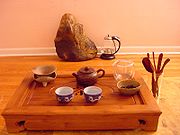
A typical
Origin The first known treatise on the subject of gongfu cha was first mentioned in Lu Yu's The Classic of Tea (8th century) and has been popular since the Qing Dynasty. In gongfu tea (literally meaning "tea brewed with great skill") rather than focusing on symbolic hand gestures such as that of the Japanese tea ceremony, the taste of the tea is paramount. Although gongfu cha brewing method does have uncompromising steps, it is important to note that the various Asian tea consuming cultures have added local styles and equipment; adding to the richness of the Asian tea culture.
Chemistry and physics behind gongfu chaIn essence, what is desired in gongfu cha is a brew that tastes great and is satisfying to the soul. Tea masters in China and other Asian tea cultures will study for years perfecting this method in order to do so. However, method alone will not determine whether a great cup of tea will be produced. It has been suggested that the chemistry and physics behind Gong fu cha is what makes this method far superior to any other when brewing Chinese teas. Essentially, two things have to be taken into consideration: chemistry and temperature.
ChemistryWater should be given careful consideration when conducting Gongfu Cha. Water which tastes and/or smells bad will adversely affect the brew. However, distilled or extremely soft water should never be utilized as they are deficient in crucial minerals and so can result in a "flat" tasting liquor. For these reasons, most tea masters will use a good clean local source of spring water. If this natural spring water is not available, bottled spring water will suffice. Hard water should be avoided at all cost, even after it has been filtered.
TemperatureDuring the process of brewing Gongfu cha, the tea master will first determine what is the appropriate temperature for the tea being used in order to extract the essential oils of the tea. An optimal temperature must be reached and maintained.
Tools/equipment/utensils
There are several extra utensils required in the Taiwan-style Gongfu tea ceremony:
Boiling waterThe boiling water temperature depends on the type of tea used.
The temperature of the water can be determined by timing, as well as the size and the sizzling sound of the air bubbles.
The above rules cannot be applied in highlands as the water will boil at lower temperatures in higher altitudes. |
|
| Author锛? 銆€銆€銆€Source锛? 銆€銆€銆€ Editor锛? Yang Fan | |


