涓枃绠€浣?/a>銆€|銆€


| Oolong Tea | |||||
http://english.dbw.cn銆€銆€
2009-05-26 15:35:02
|
|||||
|
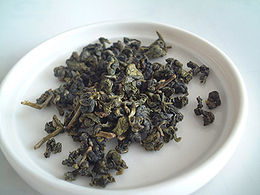
Oolong tea(traditional Chinese: 鐑忛緧; simplified Chinese: 涔岄緳; pinyin: w奴l贸ng) is a traditional Chinese tea (Camellia sinensis) somewhere between green and black in oxidation. It ranges from 10% to 70% oxidation.It is among the most popular types of teas served in typical Chinese restaurants. In Chinese tea culture, semi-oxidized oolong teas are collectively grouped as q墨ngch谩 (Chinese: 闈掕尪; literally "clear tea").Oolong has a taste more akin to green tea than to black tea: it lacks the rosy, sweet aroma of black tea but it likewise does not have the stridently grassy vegetal notes that typify green tea. It is commonly brewed to be strong, with the bitterness leaving a sweet aftertaste. Several subvarieties of oolong, including those produced in the Wuyi Mountains of northern Fujian and in the central mountains of Taiwan, are among the most famous Chinese teas. Oolong tea leaves are processed in two different ways. Some teas are rolled into long curly leaves, while some are pressed into a ball-like form similar to gunpowder tea.The former method of processing is the older of the two. The name oolong tea comes into the English language from the Chinese name (traditional Chinese: 鐑忛緧鑼?, which is pronounced as O路-li么ng t锚 in the Min Nan spoken variant. The Chinese name means "black dragon tea". There are three widely accepted explanations on how this Chinese name came about. According to the "tribute tea" theory, oolong tea was a direct descendant of Dragon-Phoenix Tea Cake tribute tea. Oolong tea replaced it when loose tea came into fashion. Since it was dark, long and curly, it was called the Black Dragon tea. According to the "Wuyi" theory, oolong tea first existed in Wuyi Mountain. This is evidenced by Qing dynasty poems such as Wuyi Tea Song (Wuyi Chage) and Tea Tale (Chashuo). It was said that oolong tea was named after the part of Wuyi mountain where it was originally produced. According to the "Anxi" theory, oolong tea had its origin in the Anxi oolong tea plant. A man named Sulong, Wulong or Wuliang discovered it. Another tale tells of a man named Wu Liang (later corrupted to Wu Long, or Oolong) who discovered oolong tea by accident when he was distracted by a deer after a hard day's tea-picking, and by the time he remembered about the tea it had already started to oxidize.
W菙y铆 cliff tea (姝﹀し宀╄尪 W菙y铆 y谩n ch谩) from F煤ji脿n province 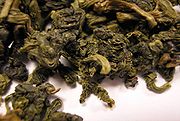
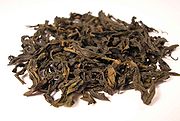
Wuyi Qi Lan Oolong tea leaves
The most famous and expensive Oolong teas are made here but the production is still usually accredited as organic. A lot of Shu菒 Xi膩n is grown elsewhere in Fujian. Some of the better known cliff teas are:
|
|||||
| Author锛? 銆€銆€銆€Source锛? 銆€銆€銆€ Editor锛? Yang Fan | |||||