 涓枃绠€浣?/a>銆€|銆€


| Black tea | |
http://english.dbw.cn銆€銆€
2009-05-26 09:26:01
|
|
|
Black tea is a variety of tea that is more oxidized than the oolong, green, and white varieties. All four varieties are made from leaves of Camellia sinensis. Black tea is generally stronger in flavor and contains more caffeine than the less oxidized teas. Two principal varieties of the species are used, the small-leaved Chinese variety plant (C. sinensis sinensis), also used for green and white teas, and the large-leaved Assamese plant (C. sinensis assamica), which was traditionally only used for black tea, although in recent years some green has been produced.
In Chinese and Chinese influenced languages, black tea is known as "crimson tea" (绱呰尪, Mandarin Chinese h贸ngch谩; Japanese k艒cha; Korean hongcha), perhaps a more accurate description of the colour of the liquid. The name black tea, however, could alternatively refer to the colour of the oxidized leaves. In Chinese, "black tea" is a commonly used classification for post-fermented teas, such as Pu-erh tea. However, in the Western world, "red tea" more commonly refers to rooibos, a South African tisane.
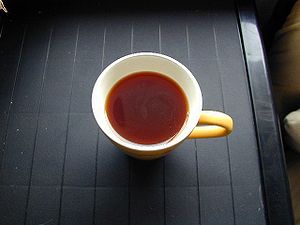
Black tea
While green tea usually loses its flavor within a year, black tea retains its flavour for several years. For this reason, it has long been an article of trade, and compressed bricks of black tea even served as a form of de facto currency in Mongolia, Tibet, and Siberia into the 19th century.[1] It was known since the Tang Dynasty that black tea steeped in hot water could also serve as a passable cloth dye for the lower classes that could not afford the better quality clothing colours of the time. However, far from being a mark of shame, the "brown star" mark of the dyeing process was seen as much better than plain cloth and held some importance as a mark of the lower merchant classes through the Ming Dynasty. The tea originally imported to Europe was either green or semi-oxidized. Only in the 19th century did black tea surpass green in popularity.Although green tea has recently seen a revival due to its purported health benefits, black tea still accounts for over ninety percent of all tea sold in the West. The expression "black tea" is also used to describe a cup of tea without milk ("served black"), similar to coffee served without milk or cream. Chinese black teas
|
|
| Author锛? 銆€銆€銆€Source锛? 銆€銆€銆€ Editor锛? Yang Fan | |


