涓枃绠€浣?/a>銆€|銆€


| Opinion: Ambitious Luchuan Succeeds | |
http://english.dbw.cn銆€銆€
2009-05-15 09:59:00
|
|
|
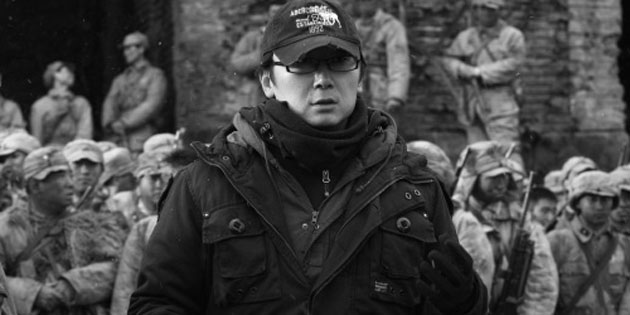
Director Lu Chuan on this file photo. Since "The city of life and death", a historical epic movie also known as "Nanking, Nanking," made its debut on April 23rd, a heated debate provoked by the film has ensued. The most controversial topic is the way Lu Chuan, the movie's director, represents the massacre of Nanking. The Nanking Massacre, which claimed over 300 thousand lives in 1937, is one of the blackest chapters in China's history. However, until today, some Japanese people are still denying, explaining away or minimizing the scale of the incident. Therefore, it's so sensitive that any expression about the bitter chapter is sure to attract people's attention. For any director, it would be a great challenge to make a movie recreating this history. Ambitious director Lu Chuan took the challenge and started shooting in 2007, the 60th anniversary of the Nanking Massacre. The director created the character of a Japanese soldier to tell the story, as he witnesses and participates in the atrocities by Japanese armies, and experiences a tremendous impact from the bottom of his heart. At the end of the movie, he commits suicide because of a sense of guilt. Some people think creating such a fictional role downplays the violence of Japanese aggressors, because the role completely subverts the traditional image of the Japanese soldiers who are usually considered to be merciless and vicious. Especially two details in the film have aroused debate among both movie-goers and movie critics. One is the drum ceremonies held by Japanese armies to memorize the dead in the war and the other is the Japanese soldier's death, he killed himself after releasing two Chinese captives. Some people have been critical of this, saying it's impossible to know how these events could have actually occurred in history. In response to the public, Director Lu Chuan argued that 'The city of life and death' was written and directed after examining detailed historic materials, such as the published diaries of Minnie Vautrin, John Rabe and some Japanese soldiers who witnessed the 1937 Nanking Massacre. As for the drum ceremony, it comes from the ordinary lives of Japanese soldiers and variations of it were used as a propaganda tool which called on the Japanese to pledge allegiance to militarism during World War鈪? Despite all of the controversies Lu Chuan has succeeded in two aspects: first, the movie's box office receipts have exceeded 100 million Yuan in the first ten days, therefore Lu Chuan has become the fifth member of Chinese film industry's 100-million-club after his peers: Feng Xiaogang, Zhang Yimou, Chen Kaige and Ning Hao. Secondly, his courageous attempt to represent this historical tragedy in a different way has spurred widespread discussion throughout China, and this will encourage more people to rethink this chapter of history. |
|
| Author锛? Ouyang 銆€銆€銆€Source锛? CRIENGLISH.com 銆€銆€銆€ Editor锛? Wu Qiong | |