|
Harbin Songhua River Railway Bridge was built in May 1900 and was put into use in October 1901. It is the first single-track railway bridge of Zhongdong Lu鈥檚 west line (Binzhou Line). It was called the first Songhua River Bridge during that time.
he bridge supervisor was A N Lentovskii, a Russian bridge expert and chief engineer of Zhongdong Railway Bureau, while the Engineer was Alekserof, who was responsible for construction. The bridge itself is 949.185 meters long and the piers are built from granite, so it is very solid.
The bridge witnessed transportation services from Zhongdong railway, which changed Harbin from a town to an important trade city. It has been in service since the end of the Qing Dynasty, Republic of China, Japanese Puppet State and The People鈥檚 Republic of China. The service not only moved passengers and cargo but also soldiers from Tsarist Russia, Allies and the Japanese army that invaded China through the bridge. Many migrants from many countries in the early time of Zhongdong railway and Russian migrants also passed over the railway bridge. The Chinese leaders at that time walked the red march from here.
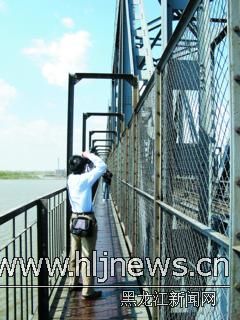
After the founding of the PRC, the Songhua Railway Bridge was not only the important bridge of the Binzhou Line, having the task of transportation, but also having become a famous scenic spot of Harbin. All locals and tourists come to the Songhua River to look over or get close to the bridge in different seasons and take photos. In summer, many locals go to the Sun Island via bridge.
In July 1962, the bridge was reinforced.
These days, Harbin Songhua River Railway Bridge still stands firmly in the Songhua River. Russian 鈥?900鈥?and 鈥?901鈥?respectively carved into the piers at the two ends of the bridge and can be clearly seen. 3 bridge towers in the South and North still exist, but only Harbin reserve the 3 bridge towers.
One of the bridge towers was appointed to the second-class protection of construction in 1997 while the bridge and bridge towers were included in the scope of the census of China's National Heritage.
|