涓枃绠€浣?/a>銆€|銆€


| National Treasures Shining in Hainan | |||||
http://english.dbw.cn銆€銆€
2009-04-23 14:48:00
|
|||||
|
Altogether 66 national treasures from the National Museum of China are currently being exhibited at the Hainan Provincial Museum of Haikou. Opened on April 1, the ongoing exhibition will run through June 2 to showcase precious cultural relics including the Square Zun with four sheep, the Jade burial suit of the Western Han Dynasty (206BC-AD24), the Qin terracotta warriors and horses and other notable artifacts. Jade burial suit of the Western Han Dynasty
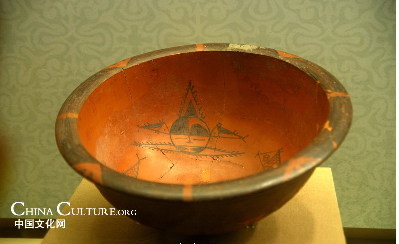
Unearthed from the tomb of Marquis Huai of the Western Han Dynasty, the jade burial suit consists of 1,203 pieces of jade and 2,567 grams of gold thread. Ancient Chinese believed that jade had magical properties and would prevent the decay of the body. So when the royal aristocrats died, jade was sewn into human-shaped burial suits with silver or golden threads to wrap the dead bodies. Basin painted with the design of human face and fish Excavated in the 1950s in Banpo Village in Xi'an of Shaanxi Province, the basin painted with the design of human face and fish is the most representative ware of Yangshao culture which is named after the village name where the first such site was discovered. As an important Neolithic culture in the middle reaches of the Yellow river, Yangshao period extended from about 4500-2500 B. C. and Shaanxi province was the center of this culture for its large quantity of cultural sites.
Putting dead children into funeral urns as a form of coffin was a popular custom in Yangshao culture. The basin was supposed to cover the urn and be buried together close to the house. Painted with a human face and two fishes at the ears, the pottery basin, according to some scholars, was used in funeral rituals to call back the spirit of the dead child. The basin is the oldest cultural relic in this exhibition. It is uniformly red in color and decorated with black pigment and its meaningful pattern is concluded not only used for blessing but also should be a totem of ancient Banpo people. |
|||||
| Author锛? Feng Hui 銆€銆€銆€Source锛? chinaculture.org 銆€銆€銆€ Editor锛? Wu Qiong | |||||