涓枃绠€浣?/a>銆€|銆€


| Carving Elegance | |||||
http://english.dbw.cn銆€銆€
2009-04-21 10:24:49
|
|||||
|
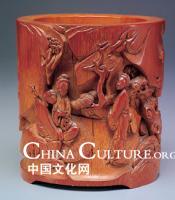
Two Representative Schools of Bamboo Carving Very few bamboo carvings pre-date the Ming Dynasty (1368-1644), but mid-Ming-Dynasty bamboo carvings have become a professional industrial art, and more and more artists have taken it up, shifting its role from practical use into an art form. Jiading and Jinling areas that teemed with bamboo were the two bamboo-carving centers during the Ming and Qing (1644-1911) dynasties. The Jiading School was represented by Zhu He, Zhu Ying and Zhu Zhuizheng, who were three generations of the same family. They were all good at painting, embossment and round carving, among which the embossment consists of bass and high embossments. With the efforts of the Zhu family, the Jiading School became the biggest branch of bamboo carving in the world of that period. Carvers like Hou Xiaozeng, Shen Dasheng, Wang Yongfang, Wang Zhiyu, Wangzhi, Wu Zhifan, Shi Tianzhang, Zhoupo and Gu Zhangyu were all outstanding members of this school. The Jinling School featured another style, which paid no attention to the exquisite carvings, and pursued natural tastes with a minimal cut and polish. Its main technique was the bamboo concave carving, which not only involved lines but also the side inlays of the bamboo and could vividly recreate the sentiment embodied in the landscape. The Jinling School was set up in the mid-Ming Dynasty by Pu Zongqian, and it was unfortunate that his craftsmanship was not handed down after his death. |
|||||
| Author锛? 銆€銆€銆€Source锛? chinaculture.org 銆€銆€銆€ Editor锛? Wu Qiong | |||||