涓枃绠€浣?/a>銆€|銆€


| Top Ten New Archeological Discoveries | |
http://english.dbw.cn銆€銆€
2009-04-08 15:52:18
|
|
|
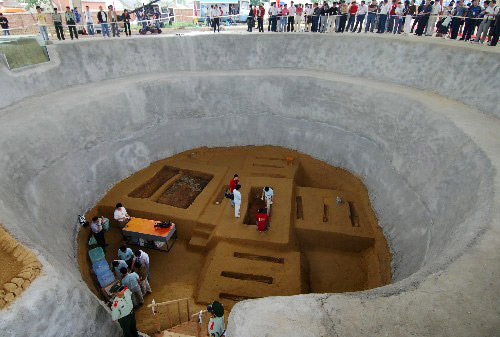
The Royal Tomb of Kingdom Han in central China's Henan Province was also honored as one of the Top Ten New Archeological Discoveries of 2008. According to Ma Juncai, the leader of the exploring team, this tomb was confirmed to be owned by the emperor Han, a kingdom that existed during the 3rd century BC. The artifacts and the structure of the tomb have filled a blank in China's archeological research.
The Royal Tomb of Kingdom Han [from www.qq.com] Ma Juncai and his team members began to dig the tomb since 2006, and now the excavation zone has covered an area of more than 12,000 square meters. The original purpose of the work is to co-ordinate with the South-to-North Water Diversion project and protects the cultural heritage along the routes of the project. The South-to-North Water Diversion project is a major program to ensure the water supply for farming, industry and life in northern China. It is planned to channel water from the Yangtze River into the southern part of the country to the north through three canals in the western, central and eastern parts of China respectively. The major part of this project began in 2002 and is expected to be completed in 2010. According to the preliminary statistics from the State Administration of Cultural Heritage, the program would submerge more than 700 historical sites. Tong Mingkang, the vice director of the administration, tells of their responsibility. The routes of the South-to-North Water Diversion project run through the country and cover many regions with rich culture. Henan in central China, Hubei in the south and Shandong lying on the east... All of these provinces used to be great flourishing points of traditional Chinese culture. Before the project, the government had implemented archeological research in these areas, and the results turned out to be fruitful. According to the judge Xu Pingfang, in recent years, one of the focuses of the Chinese archeological field was to co-ordinate with the South-to-North Water Diversion project. Researchers from different cities or even different provinces had worked jointly, rescuing and protecting cultural relics from being inundated. This time, most of the candidate discoveries on the Top Ten list were found in the protection work coordinated with the water diversion project.
<<previous [1] [2]
|
|
| Author锛? 銆€銆€銆€Source锛? CRIENGLISH.com 銆€銆€銆€ Editor锛? Wu Qiong | |