|
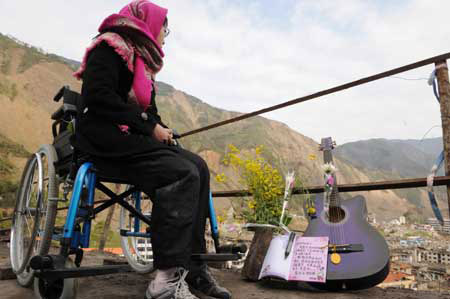
A woman mourns her child killed during the devastating earthquake striking southwest China's Sichuan Province May 12, 2008, in Beichuan County, southwest China's Sichuan Province, April 4, 2009. [Photo: Xinhua]
April 4 is the first Tomb Sweeping Day, also known as the traditional Qingming Festival, after the 8.0-magnitude earthquake that devastated southwestern China's Sichuan and neighboring provinces last May 12.
Survivors have returned to quake-leveled hometowns to mourn their deceased relatives, while netizens have sent flowers and messages online to victims. The quake claimed 69,225 lives.
But tears and flowers are not enough. To some extent, government summaries of relief work and proposals for future reconstruction in quake-hit areas are more important offerings for those killed in the earthquake, because their survivors must live on.
Therefore, the Qingming Festival is not only a day to clean tombs and mourn loved ones, but also a special occasion to reexamine the lives of the living. It is time to reflect upon what we have done and what we need to do in the future.
The participation of young Chinese in last year's quake relief work won widespread praise from all, including President Hu Jintao. Hu hailed young people's adamant spirits in the fight against the quake and added that the country could rely on them. Before that, those born during and after the 1980s, known as the "post-80s generation," used to be called the "troubled generation" in China.
But critics said the work and other contributions of young Chinese in the immediate aftermath of the quake were nothing more than spontaneous reactions to a devastating tragedy. They suggested not making hasty conclusions about whether China's post-80s generation could be relied on, but to draw conclusions based on their long-term participation during the post-quake reconstruction period.
Now, nearly a year has passed since the May 12 earthquake, and we are happy to see that the enthusiasm of the young Chinese has not faded. Besides thousands of young volunteers who are still working in the quake-hit areas, millions of netizens- mainly young people- are keeping a close watch on the reconstruction work in Sichuan.
The proposal to build an earthquake museum estimated to cost 2.3 billion yuan (about 340 million U.S. dollars) recently spurred controversy nationwide. Both the media and Chinese netizens responded discontentedly, arguing that that the museum should be as simple as possible so as to save money for survivors and reconstruction.
Because of their discontent, officials had to explain the plan, saying that the museum itself would cost only 135 million yuan (20 million U.S. dollars). The 2.3-billion-yuan plan also includes environmental protection work and road construction.
In early 2009, the government of Beichuan County, one of the worst-hit areas in Sichuan Province bought a 1.1-million-yuan luxury Toyota Land Cruiser. After news of the vehicle purchase appeared on the Internet, netizens slammed the government's extravagant spending, although local officials argued that the vehicle would be used as a wireless communications car for emergency rescue and disaster relief work. Later, the local government sold the luxury vehicle to appease public indignation, and officials involved in the matter apologized.
If the fatal quake has brought something positive in addition to all the misery it left in its wake, it must be the promotion of civic awareness. The Chinese- especially young people- now realize that relief and reconstruction efforts in the disaster-hit regions are not only a government obligation, but also the responsibility of all Chinese.
Thanks to an increase in public concern, the ongoing post-quake reconstruction during the last 11 months has been undertaken in a transparent and effective manner.
As for the future, we have many things to do. For example, as the first anniversary of the May 12 quake approaches, some of those affected by the trauma will face a new psychological crisis. Experts have called on mental health workers to offer counseling, education and support group activities to survivors to help them prepare for and cope with the quake's anniversary.
|
 涓枃绠€浣?/a>銆€|銆€


