涓枃绠€浣?/a>銆€|銆€


| Treasures in Taipei | |||||||
http://english.dbw.cn銆€銆€
2009-03-31 10:19:58
|
|||||||
|
Imprint by the Directorate of Education
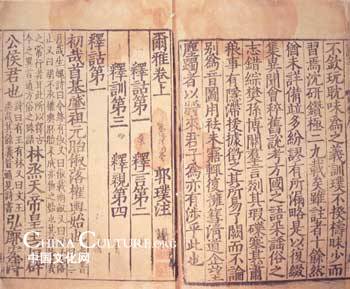
Southern Song Dynasty (1127-1279) This Er-ya dictionary with annotations by Guo Pu is one of the rare extant editions printed at the Southern Song Directorate of Education. The text is circumscribed by a black border of 22.8 x 16.2 cm, which consists of double lines on the right and left sides of the page. Along the outer folded edge of the page, the top specifies the total number of characters per page, while the bottom lists the name of the carvers. Each folded page contains 8 rows of 116 large characters with commentary in double lines of 21 characters. The last two pages of this edition were hand-copied. Woodblock printing technology made great strides during the Song Dynasty. Not only did central and local governments expend considerable efforts in editing and printing books on Confucian classics, official histories of previous dynasties and tomes of classified compilations, scholars would also have their writings and works of their ancestors printed in "private print editions" while bookshops made profit-oriented imprints for those preparing to take civil service examinations. Windy Pines Among a Myriad Valleys
Northern Song Dynasty (960-1127) Ink and Color on Silk By Royal Painting Academy Painter Li Tang 188.7cm long and 139.8cm wide This important and rarely shown painting is "distant views from multiple focal points," a style employed by Northern Song landscape painters to emphasize the grandeur of mountains and the harmonious relation between nature and humans. Guo Xi鈥檚 "Early Spring"
Made in 1072 158.3cm long and 108.1cm wide Water-ink Painting on Silk Early Spring is considered one of the great masterpieces of the Northern Song monumental landscape tradition. It is a rare example of an early painting executed by Guo Xi, a court professional who signed and dated his work. Guo Xi developed a strategy of depicting multiple perspectives called "the angle of totality." Because a painting is not a window, there is no need to imitate the mechanics of vision and view a scene from only one spot. Like most Song landscape artists, Guo Xi used texture strokes to build up credible, three-dimensional forms. Strokes particular to his style include those on "cloud- resembling" rocks, and the "devil's face texture stroke," which is seen in the somewhat pock-marked surface of the larger rock forms. Guo Xi's paintings often contained three types of trees. The lesser, bending trees Guo Xi described anthropomorphically as holding one's creeds within oneself; the crouching, gnarled trees were seen analogous to an individual clinging to his own virtues; and the vertical trees were compared to those individuals who remain abreast of their environmental conditions (politics) and flourish. (dbw.cn) |
|||||||
| Author锛? 銆€銆€銆€Source锛? chinaculture.org 銆€銆€銆€ Editor锛? Wu Qiong | |||||||