涓枃绠€浣?/a>銆€|銆€


| Tibetan Buddhism: Sacred traditions have down-to-earth side | |||||
http://english.dbw.cn銆€銆€
2009-03-11 16:25:56
|
|||||
|
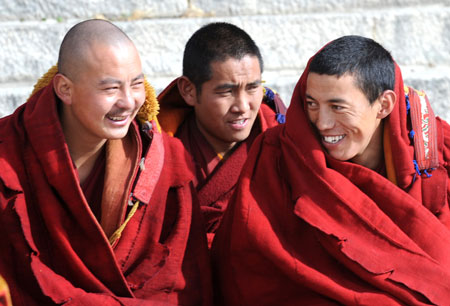
He played and joked with a friend on the way, like any other young man might do, but when the scarlet-robed lama arrived at the monastery, he suddenly became quiet and serious. He began chanting mantras in chorus. "All lamas must do this, and I must do it well," said Losang Zaxi, 20, who joined the Tashilhunpo Monastery of Xigaze in 2000. The quiet boy, a native of Xigaze, graduated from a village primary school. He didn't want to study any more, so he became a lama, at least partly because it seemed like a good job where he would be respected by followers of Buddha.
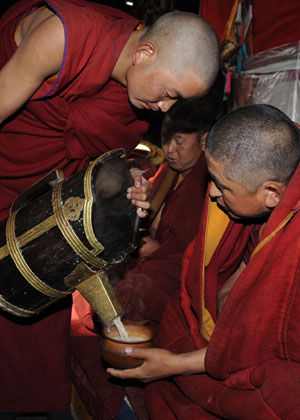
In the first year, Losang was an apprentice, like he might have been at an ordinary job, and he couldn't wear the robe for a year. It seems he hadn't escaped studying after all: he had to pass an exam. The test wasn't too hard, because he studied diligently, but a monk's life took some getting used to. "Being a lama was more difficult than school, because there were so many rules to follow in the monastery." Life in a monastery has a regular pattern. Losang rises at 5:30 a.m. in the summer and 6 a.m. in the winter, amid the sounds of mantra chanting. Breakfast is zanba, a traditional dish made of barley flour, washed down by ghee tea. After lunch, there's a two-hour rest period. Afternoon study starts at 3:30 p.m., when the monks learn politics, laws and the religion, culture and history of Tibet. "I'd like to get a geshe degree," said Losang. Geshe degree is an academic qualification for monks. It might sound dull to many young men, but Losang said his life was not all that different from that of his peers. "I watch TV and listen to pop music too," he said, adding that he had watched the Tibetan language version of "A Journey to the West," based on a Chinese novel.
He also liked the movie "Huo Yuanjia," a film about a martial arts hero. During the Beijing Olympic Games, he watched many events on TV. He was especially interested in Yang Wei, who won a gold medal in gymnastics, and Yao Ming, the basketball player. When it came to foreign players, he said his favorites were the Brazilian footballers Ronaldo Ronaldinho and the Portuguese star Cristiano Ronaldo. He said he also followed "big national issues," like cross-Straits relations. "They are improving," he said. "I hope I could see one day Taiwan and the Chinese mainland reunite." Losang also has a mobile phone that he uses to exchange messages in Tibetan and Mandarin Chinese with his friends every day. Internet cafes, however, are strictly off-limits for members of the Tashilhunpo Monastery. "There are too many temptations on the Internet. Once a monk is addicted, his study of Buddhism would be affected," said Losang Yignyen, 30, who is an assistant to Salung Phunlha, deputy chief of the monastery. MODERNIZED MONASTERY Buddhism was introduced to Tibet in the 7th century, during the reign of Songtsen Gampo (617-650), when China was in its prosperous Tang Dynasty (618-907) period. Trisong Detsen (755-797) made Buddhism the official religion in the 8th century. Songtsen and Trisong were rulers equivalent to kings or emperors in medieval Tibet. Tibetan Buddhism combined politics with religion, a link that was broken by democratic reform. Under the old system, the Dalai Lama was not only the spiritual leader but also the secular ruler of Tibet. The Tashilhunpo Monastery, about 300,000 square meters in size, took 12 years to build in the mid-1400s. According to Salung, the monastery now houses more than 800 lamas, with fewer than 300 young men like Losang. In the 1950s, there were nearly 5,000 lamas in the monastery. Although the number was larger, Salung said many of them were not really willing to be lamas. "They fell into three categories: pious believers, children of poor serfs who entered the monastery to make a living and those sent to temples to meet a quota," he said. Temples had quotas for the serfs, and those who joined for this reason were called zunzhas. Among the ranks of lamas, more than 70 percent were from impoverished families, he said. Salung said he didn't recall how many manors were formerly owned by the Tashilhunpo Monastery. Monasteries, along with aristocrats and government officials, were among the landowners in Tibet at that time. An exhibition at the Museum of Tibet showed that they owned about 36.8 percent of arable land in the plateau region before 1959. Farmers worked the land under contract and had to turn in grain, ghee and fodder as tax. Hence, each lama at the temple could get 42 kilograms of food per month without doing any of the work it took to produce the food, said Qiangba, 64, a former lama in Tashilhunpo. Although China is a socialist country, Buddhism is protected according to national policy. The late Chairman Mao Zedong said when he received delegations from Peru in 1964 that "it is wrong to tell people to be against religion." He said that if China did so, "religious people would oppose us... believing in a certain religion doesn't mean people don't oppose imperialism, feudalism and bureaucratic capitalism." After democratic reform in 1959, the manors and land were confiscated. Some 3,000 lamas left for a secular life. The question then arose: how could the remaining lamas survive? After democratic reform, lamas could no longer get food from farmers. They were still each entitled to a ration of 0.25 kg of ghee and 14 kg to 28 kg of grain per month, depending on their age. Those amounts of food weren't enough to live on, however, and they had to work. That meant only four days a week could be devoted to Buddhist ceremonies, Qiangba recalled. |
|||||
| Author锛? Bai Xu, Hu Xing, Li Huizi and Yi Ling 銆€銆€銆€Source锛? xinhua 銆€銆€銆€ Editor锛? Yang Fan | |||||