涓枃绠€浣?/a>銆€|銆€


| Chinese Indignation against Christie's Auction | |
http://english.dbw.cn銆€銆€
2009-02-24 08:59:56
|
|
|
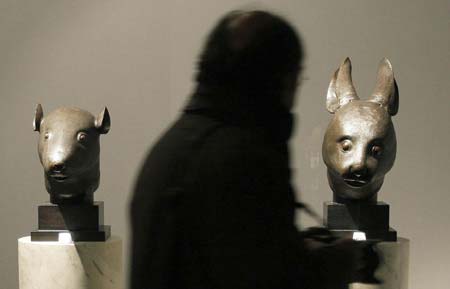
A bronze rabbit head and rat head made for the Zodiac fountain of the Emperor Qianlong's Summer Palace in China are displayed during the exhibition of the private art collection of French fashion designer Yves Saint Laurent and his partner Pierre Berge at the Grand Palais in Paris February 21, 2009.[Photo: Xinhua] Christie's, a France auction house, is reportedly planning to proceed as scheduled with its obstinate-enough auction of two Chinese relics, the bronze rabbit and rat bust sculptures, despite widespread anger and opposition throughout China. Besides voices from China's foreign ministry, demanding the return of the looted bronzes, Chinese civilian organizations have also made efforts to have the relics returned. A team of over 80 Chinese lawyers has lodged a motion in a French court, trying to stop Christie's sale of these stolen relics, which were once housed in Beijing's Old Summer Palace, also known as Yuanmingyuan. The bronzes were stolen in 1860 when Anglo-French allied invaders looted and then burned down the imperial palace. The auction of stolen items has received so many website hits and so much press coverage in China that even the U.S. newspaper, The New York Times reported it on February 16, attributing those angry voices to "the rising nationalist sentiment in China". This argument implies a stronger trend that Chinese people are changing, as the way in which they express their discontent has changed. One and a half centuries ago, when French and British forces looted the Old Summer Palace on the outskirts of Beijing, Chinese people expressed their strong resentment through poems and lyrics. Nowadays, on hearing that Christie would go ahead and take the risk to auction the stolen relics, Chinese people have again voiced their anger either online or through other modern forms of media. However, Chinese people's attitude towards such shameful actions never changed. They want their treasures back. Therefore, the word "rising" should be replaced by "long-existing" so as to maintain an accuracy in that remark from the New York Times. Moreover, such an attitude is not unique to Chinese or to nationalists. When thieves break into one's house and steal their private collections, the person, no matter a nationalist or an internationalist, no matter a Chinese, a Frenchman or an American, will definitely be angered and want their belongings returned. Probably, only saints would say, "OK, take them and keep them. That's all right." If we further suppose that a few years later that the person sees their stolen property displayed for sale, would he or she write a check promptly or immediately call the police? In fact, anger and dissatisfaction is merely a sort of spontaneous response from ordinary people, having nothing to do with those vague terms such as nationalism. 2009 is the year of ox according to Chinese lunar calendar based on the Chinese zodiac, in which signs of 12 animals run in an established order over a 12-year cycle. The 12 animals, namely, rat, ox, tiger, rabbit, dragon, snake, horse, sheep, monkey, rooster, dog and pig rotate in the order for every 12 years, as well as every day. According to the lunar calendar, one day is also divided into 12 sections, with each section covering two hours. From 11pm to 1am is the first section called 'Zi Shi', which means 'the time period of rat'. In short, the zodiac is used in not only naming years but also measuring hours. Although it is hard to tell how the 12-animal zodiac came about, yet no one would deny that these are important symbols of Chinese culture. People can find them everywhere in China, and among the Chinese groups living around the world, ranging from widespread legends, culture relics to today's stamps, greeting cards and even children's books. If we could travel back to the year of 1860, we would see all of them in the former Summer Palace. Twelve bronze sculptures depicting the twelve animals were made for a Zodiac fountain, or water clock there. However, those unfortunate bronzes' heads were cut off by the invaders and stolen abroad. To bring some of these priceless relics home, Chinese have again paid a lot: -In 2000, the China Poly Group Corporation bought the ox, monkey and tiger heads for respectively HK$7.4 million, HK$8.18 million and HK$15.44 million at auctions held by Christie's and Sotheby's. -In 2003, a Chinese foundation bought the bronze pig head from a U. S. collector through a private sale. -In 2007, Macao gaming tycoon Stanley Ho Hung-sun bought the bronze horse head for HK$69.1 million and donated it to the motherland when Sotheby's planed to auction the bronze. This time, the two bronzes are expected to sell for as much as 10 million USD each, sources said. But, we have to remind the Christie's that there is no reason that China, which has suffered culturally from the loss of treasures and the ruin of the Summer Palace, should remain silent, and that Chinese have the legitimate right of ownership of the priceless reliecs, although it may argue that business is business to them in someway. (Northeast web) |
|
| Author锛? Xu Leiying 銆€銆€銆€Source锛? CRIENGLISH.com 銆€銆€銆€ Editor锛? Wu Qiong | |