涓枃绠€浣?/a>銆€|銆€


| China vows to press forward with economic reforms and opening-up | |||||
http://english.dbw.cn銆€銆€
2008-12-19 09:17:57
|
|||||
|
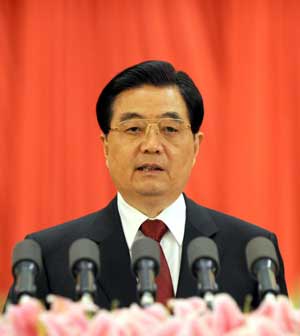
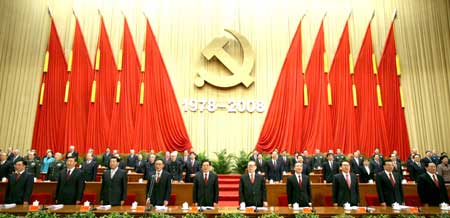
President Hu Jintao said on Thursday that China must press forward the reform and opening-up drive, which in the past 30 years turned the once poverty-stricken country into one of the world's largest economies. Hu said significant changes in China proved that the direction and path of reform and opening-up are "completely correct". "Standing still and regressing will lead only to a dead end," Hu told an audience of more than 6,000, which included former President Jiang Zemin and other Chinese leaders Wu Bangguo, Wen Jiabao, Jia Qinglin, Li Changchun, Xi Jinping, Li Keqiang, He Guoqiang and Zhou Yongkang.
The event, which started at the Great Hall of the People in downtown Beijing at 10:00 a.m., was held to commemorate the 30th anniversary of the 3rd plenary session of the 11th Central Committee of the Communist Party of China (CPC). It was at that meeting when the Party decided to open up the country and reform its moribund economy. The decision, which saved China from an economic breakdown after the chaotic 10-year Cultural Revolution (1966-1976), was masterminded by Deng Xiaoping who was later called "chief architect" of the reforms, together with his comrades who were bold enough to change the old norms. Hu said the meeting 30 years ago ushered in a new historic period of reform and opening-up, marking the most significant turning point in the Party's history since the New China was founded in 1949. Thursday's anniversary event fully recognized the significance and great achievements of the reforms and emphasized that the country will continued the development with "Chinese characteristics." TREMENDOUS CHANGES When Gu Xiulian visited France and Germany during a study tour of textile machinery in the summer of 1978, she was taken back by the amount of western affluence. "I was vice minister of the State Planning Commission then, but even I had to buy food with stamps, even for a bottle of sesame jam," said Gu, vice chairwoman of the Standing Committee of the National People's Congress from 2003 to 2008. "At that time people didn't have enough food and clothing," she said. "Ordinary people suffered most." Thirty years after the trip, the average annual disposable income of Chinese urban residents grew 6.5 times from 343 yuan (50.4 U.S. dollars) in 1978 to 13,786 yuan in 2007. That's just one of several changes since the country went through reform and opening-up. Over the past 30 years, China has maintained an average annual GDP growth rate of 9.8 percent, more than three times the world average, President Hu said. Gross domestic product (GDP) soared from a mere 360 billion yuan (about 52 billion U.S. dollars) in 1978 to 24.95 trillion yuan in 2007, making China the world's fourth-largest economy. The country's poor population was reduced from 250 million in 1978 to 14.79 million in 2007. "The shortage economy, which had troubled China for a long time before the reform and opening-up drive, has been changed fundamentally," Hu said. The President said the past 30 years were a period in which China's national strength rose by a big margin. He also said Chinese people are receiving more tangible benefits than ever before. "Reform and opening-up are the fundamental causes of all the achievements and progress we have made," Hu said. CHALLENGES REMAIN Hu also cautioned the Party and the Chinese people to remain realistic. "Comparing our achievements with our long-range goals and people's expectations of a better life, we have no reason to feel content and stop moving forward." Hu said China still faced many challenges, including a low level of industrial innovation, a weak agricultural foundation, less-developed rural areas and deficiencies with Party and government work. Given the current world situation, especially the escalation and spread of the international financial crisis, China must continue to firmly focus on economic development, Hu said. "We must earnestly implement the measures (which the government has announced) to further expand domestic demand, boost economic growth as well as cope properly with the international financial crisis and various risks in the internal economy to maintain stable and relatively rapid growth of the economy," Hu said. China announced various measures to boost economic growth. Those include reducing interest rates, formulating 10 major measures to expand domestic demand and investing 4 trillion yuan within two years. Chi Fulin, the executive director of the China (Hainan) Reform and Development Research Institute, said the remaining challenges the country is facing are all "hard ones" and in ways similar to those 30 years ago. The Cultural Revolution led to political and economic turmoil, which propelled the CPC to choose reform and opening-up as a way out. Chi said the unexpected international financial crisis will also force China to continue to reform. STABILITY STRESSED WHILE DEVELOPMENT STILL BE THE GOAL While reviewing China's 30-years of growth, Hu listed 10 "musts" the Party has been doing as well as should continue to do. One of them is to emphasize reform and social stability equally. "The depth of reform and the speed of development must not go beyond society's capacity to bear," Hu said. "Reform is the impetus. Development is the goal. Stability is the precondition." "Without stability, nothing could be done. Even achievements already made could be lost," Hu warned. Hu urged the Party to keep the current "key strategic opportunities," national security and the interests of the majority in mind. Another "must", Hu said is to continuously push forward political reform so as to provide a system and legal guarantee for China's reform and modernization drive. He said the CPC had in the past 30 years given equal emphasis to political structural reform and economic restructuring and will continue reforms in the political system to provide institutional and legal support for the modernization drive. He said "people's democracy is the lifeline of socialism. People's democratic rights to be masters of their own affairs are the essence and lie in the core of China's democratic politics. Without democracy, there would be no socialism or socialist modernization." CHINA'S OWN PATH In his speech, Hu attributed China's achievements and progress over the past 30 years to the fact that China has "pioneered a socialist path with Chinese characteristics" and "formed a socialist theory system with Chinese characteristics." Hu said China would adhere to its own social system and development path and never bow to foreign pressure. The future and fate of China, as well as the rest of the world, have become increasingly interdependent, but the country should maintain its independence while participating in globalization, Hu added. For such a populous socialist country as China, independence and self-reliance should form the basis of development. Yan Shuhan, a professor with the Party School of the CPC Central Committee, said following the international financial turmoil, some have been questioning whether China should continue the market-oriented economic reforms. "President Hu's speech answered the questions," said Yan, who attended the anniversary ceremony. "He emphasized that only through development can we solve the difficulties brought on by the financial crisis." The professor said Hu's review of China's 30-year reforms also explained where China is heading. "Hu's speech told us that there is no universally applicable development mode, or an unalterable one," Yan said. "This pointed that China's reforms must be carried out in continuous innovation." |
|||||
| Author锛? 銆€銆€銆€Source锛? xinhua 銆€銆€銆€ Editor锛? Yang Fan | |||||