涓枃绠€浣?/a>銆€|銆€


| Chinese shares surge over 4%, led by banks and oils | |||
http://english.dbw.cn銆€銆€
2008-12-04 08:53:49
|
|||
|
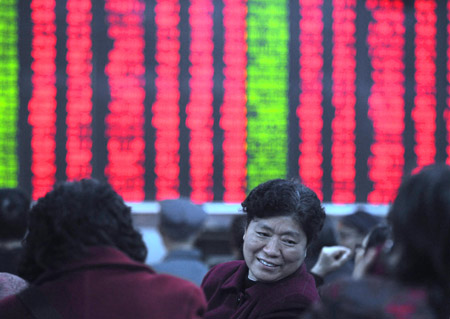
Chinese equities staged a big rally on Wednesday, with the key Shanghai index rising over four percent, which was led by gains for heavyweight banks and oils.
The benchmark Shanghai Composite Index, which covers both A and B shares, closed at 1965.41 points, up 4.01 percent or 75.78 points. The smaller Shenzhen Component Index added 245.26 points, or 3.61 percent, to close at 7041.07 points.
Gainers outnumbered losers by 860 to 6 in Shanghai and by 739 to 3 in Shenzhen. Combined turnover was up to 132.78 billion yuan (19.4 billion U.S. dollars). The surge came after China Securities Regulatory Commission chairman Shang Fulin said the regulator was considering allowing institutional investors to invest more in the equity market. The banking sector, which has been weak and dragging down the indices over the past weeks, put up an upbeat performance after China Construction Bank (CCB) said in a stock-filing that the Central Huijin Investment Co., Ltd., an investment arm of sovereign wealth fund the China Investment Corporation, had increased its CCB A-shares to 70.8 million by Nov. 28. CCB, also listed in the Hong Kong stock market, also said Bank of America had bought 19.6 billion of its H-shares from Central Huijin. As a result, nearly 20 bank stocks rose by 5.30 percent on average. CCB gained 5.20 percent to end at 4.25 yuan. The Industrial and Commercial Bank of China, the country's largest lender, rose nearly three percent to 3.87 yuan. Bank of China added 3.19 percent to finish at 3.23 yuan. Shanghai Pudong Development Bank, China Merchants Bank and Industrial Bank all jumped by more than six percent to end at 12.90 yuan, 12.49 yuan and 14.69 yuan, respectively. Oils also gained significantly and helped push up the indices. PetroChina, the largest component of the key Shanghai index, rose 2.25 percent to 11.40 yuan. Sinopec, another heavyweight, added 4.42 percent to 8.27 yuan. Insurers also rebounded from their weak performance in the last two days. Heavyweight China Life, the nation's leading life insurer, rose4.13 percent to 18.90 yuan, while Ping An Insurance jumped by 6.21percent to close at 23.95 yuan. Despite the fall in world oil prices, shares of coal producers,which market analysts believed were undervalued after continuous falls, made a huge rally with an average eight percent increase. Nearly 15 shares, including Shanxi Lanhua, Shanxi Guoyang New Energy, Yanzhou Coal Mining Company and Pingdingshan Tian'an Coal Mining, jumped by the 10 percent daily limit. Textile companies continued to benefit from the weak yuan against the U.S. dollar, which investors believed would help them increase exports. China's currency, the yuan, fell by the daily limit against the U.S. dollar for a second day on Tuesday, its fourth straight daily decline. The yuan finished at 6.8870 per U.S. dollar on the over-the-counter market, having declined 0.5 percent against its central parity rate. Golden Sun Securities said in an investment report that the stock market, despite a big rally in the day, was still faced with heavy pressure because of the uncertainties of the world economy and a large number of to-be-unlocked shares. More than 23.3 billion shares would become tradable this month as their lock-up period ended. Such a volume was the second largest this year, only after that in August, which saw about 27.55 billion shares being unlocked and traded. China started a program in 2005 to convert non-tradable shares into tradable stocks. And major shareholders of non-tradable stocks were subject to a one or two years of lock-up. |
|||
| Author锛? 銆€銆€銆€Source锛? xinhua 銆€銆€銆€ Editor锛? Yang Fan | |||