your position :English > Culture > Local Culture > Historical Culture  content
Engrossing Pingyao Lacquer
  • Futian International Costume Festival held in Shenzhen
  • Do you wanna be on top?
  • Beauty Love & 2009 China Lingerie Model Grand Contest held in Nanning
  • 2010 List of Golden Globes Nominations
  • Britain tells Alpine enthusiasts "don't drink and ski"
  • Getting set for "Happy Hanukkah"
  • http://english.dbw.cn銆€銆€ 2008-11-28 09:11:50
     

    Lacquering is the key. Craftspeople smear the grounding with varnish, use dipped sand paper to swab it over, and then rub it as smooth as possible manually. The procedure would be repeated 6-7 times with a more and more meticulous practice. Sand paper is changed from rough one to fine, then to calico, to silk, finally a wisp of hair. Lubricant used in the rubbing is at first sesame oil, then bean oil. Craftspeople are required to use their palms, the most sensitive and tender part of the hand, to rub the ware, and this is a work that exclusively belongs to women. It鈥檚 said that the tenderness and subtlety of women鈥檚 hands are the key factor in making a top-grade lacquer ware. A thousand rubs gives a jade-like luster to Pingyao lacquer; they鈥檙e as glabrous as mirrors.


    Painters to conduct the painting process must work the job no less than four years to work independently. Their most common technique is 鈥淢iao Jin Cai Hui,鈥?or colored drawing outlined in gold that uses lynx hair brush and concocted dye of gold powder. To prevent trembling when drawn on the mirror-face-like wares, painters often have in their left hand an underlay to support his right wrist. And respecting the skills of people who carve these paintings into the works, gravers must have their edges resemble calligrapher鈥檚 strokes, the styles of which vary from wild to mild. Finally setters stud the wares with colored stones, mussels, ivory and trumpet shells and adjust the decorations. All these give birth to a typical Pingyao lacquer ware.


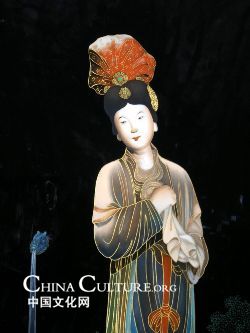
    The products of lacquer contains folding screens, chests, kitchen cabinets, cupboards and caskets, added furniture like TV cabinets and beside tables after the modern age. Most are black, almond or garnet groundings, with paintings featuring classic fiction, drama, myths and legends.
    Author锛? Liu Rong 銆€銆€銆€Source锛? chinaculture.org 銆€銆€銆€ Editor锛? Wu Qiong