|
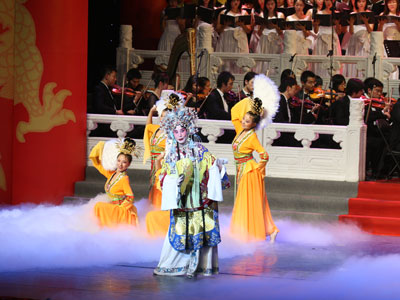
Peking Opera artists perform at Renmin University of China on October 24, 2008. [Photo: China.org.cn]
With its splendid feats of acrobatics and uniquely painted faces, Peking Opera is widely acclaimed. Yet the performers are not satisfied with their achievements - they are seeking ways to popularize the opera around the rest of the world.
To expand the international influence of the opera, performers from Renmin University of China plan to stage 20 to 30 performances abroad every year, revealed Sun Ping, executive director of the university's Research Institute on Chinese National Opera, on October 24. Additionally, they will collaborate with overseas Confucius Institutes to advance academic research in the field.
"Peking Opera is regarded as a symbol of traditional Chinese art. It is important to stage it throughout the world. It's a way to popularize Chinese culture and art," said Sun.
Peking Opera, composed of music, vocal performance, mime, dance and acrobatics, was developed by four Anhui troupes in 1790. It features four main types of performers, those being the Sheng (male role), Dan (female role), Jing (face-painted male), and Chou (clown).
Mei Lanfang, the famous Dan performer of the 1920s and 1930s, was first to take the opera abroad to Japan, the United States and the former Soviet Union. In the 1980s, Yang Qiuling popularized the opera in the University of Hawaii by singing it in foreign languages. In the 1990s, Sun Ping launched a bold move in performing the art to the accompaniment of a symphony orchestra.
"Symphony is essential to Western cultures. We adapt the music to make Peking Opera accessible to westerners," said Sun. In 2000, Ms Sun sang sections from The Red Lantern and Dujuan Mountains together with the University of Pennsylvania Symphony Orchestra. Today, more and more people are getting to know her unique art form.
Translation is another important element in popularizing Peking Opera, but progress in this area is far from satisfactory. Only 32 librettos out of over 1,000 operas have been translated into foreign languages. To help foreigners better understand Peking Opera, experts plan to translate 100 more librettos in the coming years.(Northeast web)
|
 涓枃绠€浣?/a>銆€|銆€


