涓枃绠€浣?/a>銆€|銆€


| Museums in the Stamps | |||||
http://english.dbw.cn銆€銆€
2008-10-27 09:51:20
|
|||||
|
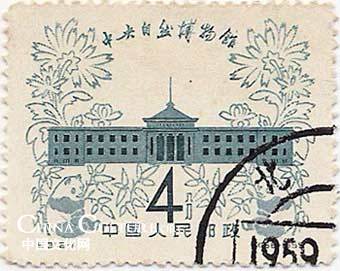
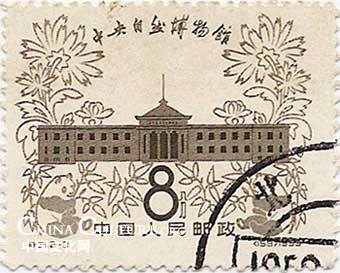
A museum is an institution for the collection of cultural relics and specimens, education and research, and as such is an important component of China鈥檚 scientific and cultural undertakings. After the founding of the People鈥檚 Republic of China (PRC), a series of museums were built, most of which have been featured as a theme on stamp鈥檚 designs. The Stamp of National Central Museum of Natural History Covering an area of 12000 square meters, the National Central Museum of Natural History was built in 1950 with 18000 square meters of building area and 6000 square meters of exhibition area. Since it was constructed under the aid of the former Union of Soviet Socialist Republics, its building was featured by Soviet style. It was renamed as Beijing Museum of Natural History in February 1962. With four basic exhibition rooms and more than 100000 cultural relics, fossils and specimens in collection, the museum is famous for the number of mammal fossils. The Ministry of Post and Telecommunication issued two kinds of stamps on April 1 1959, respectively with the postages of 4 cents (RMB fen) and 8 cents.
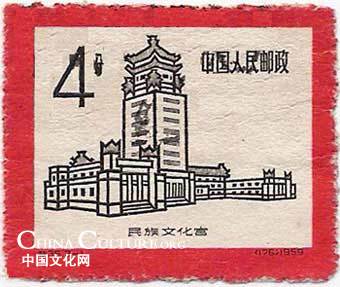
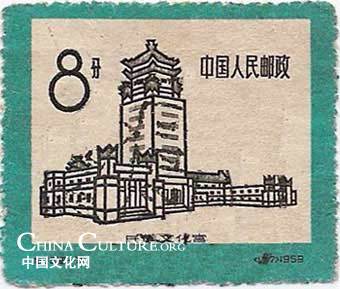
The Stamp of Cultural Palace of Nationalities
Situated at west Chang鈥檃n Road and serving as a museum, the Cultural Palace of Nationalities is an exhibition center featuring a national flavor, designed by the local Beijing Institute of Architectural Design and opened in September, 1959. It had the reputation as one of the top 10 architectural creations in Beijing to celebrate the 10th anniversary of the founding of PRC, the cultural palace of nationalities was not only chosen as the top of the fifty buildings of 鈥淢y Best Favorite Architectures of National Style鈥?in Beijing in 1994 but also listed as one of masterpieces of Modern Chinese Architectural Art by the International Union of Architects in 1999. The Ministry of Post and Telecommunication issued two kinds of stamps with the theme of Cultural Palace of Nationalities on December 10, 1959. |
|||||
| Author锛? 銆€銆€銆€Source锛? chinaculture.org 銆€銆€銆€ Editor锛? Wu Qiong | |||||