涓枃绠€浣?/a>銆€|銆€


| Ruins of Puyulu Ancient City (Jin Dynasty) | ||
http://english.dbw.cn銆€銆€
2007-09-24 15:03:21
|
||
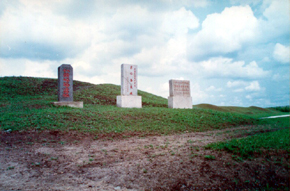
Oval in form, 3000 meters in circumference, Ruins of Puyulu Ancient City (Jin Dynasty) is located in Gucheng Village (Jincheng Township, Kedong County, Qiqihar, Heilongjiang Province) , bordering the southern bank of the Wuyur River. Built with rammed earth, the city walls have a base of 23 meters broad, and 1.5 meters at the top. Currently, the remains range from 1.7to 3.28 meters in height. There are North Gate and South Gate with enceintes, and a city moat 10 meters off the city. In the northwestern corner of the city moat stands earthen piers of oval-shape, the perimeter of which is 420 meters, which is considered as a wharf.
銆€銆€ 銆€銆€In 1975, an archaeological excavation of South Gate was conducted by the Archaeological Department of Heilongjiang Provincial Museum, which revealed that the Gate was designed to be single access with lintel. Right in the middle of the gate opening there were stone doorstoppers and the roads inside were paved with pebbles and sand. The gate tower had already collapsed years before with caved eave tiles, arched tiles and plate tiles from the caved-in roof scattering over.Further excavations in the northeastern corner of the inner city in 1979 uncovered a larger architecture site---the site of the government offices which consisted of a front courtroom and a back hall taking up floor space of 300 meters. As the essence of the building, the back hall had 3 rows of untreated plinths, spaced approximately 4 meters apart. The walls of the back hall were built with grey bricks except the north wall which was made of clay. In the east side of it were Huokang (traditional Chinese hot brick bed), and a kitchen range was in the northwest side, which was most likely the officials鈥?residential area.The excavation of these ruins provided the geographical coordinates for China鈥檚 northern boundaries in the 12th and the 13th centuries. More than 200 cultural relics were unearthed, including pottery, porcelain, bronze ware, ironware, bone objects, copper coins, etc., which provide valuable materials for future studies. |
||
| Author锛? 銆€銆€銆€Source锛? 銆€銆€銆€ Editor锛? Yang Fan | ||