中文简体


| Halfway hutong---What's left of Bingmasi holds out for history | |
http://english.dbw.cn
2011-01-14 15:28:14
|
|
|
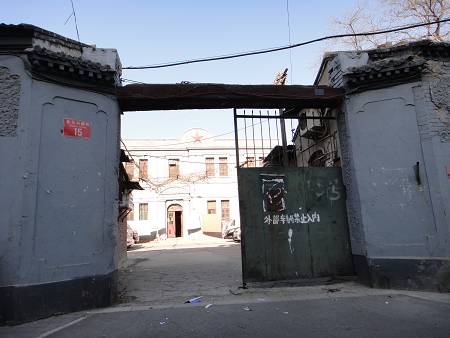
Ms Zhou, the 67-year-old resident who has lived at No.59 for more than 20 years said that the north house where she lives in the first courtyard was Xiao's private clinic. He died at the age of 90, recognized as one of the greatest TCM doctors. After his death, No.59 was not at peace. During the Cultural Revolution (1966-76), the Red Guards (Hong Wei Bing) paid a visit to this door but definitely not for medical treatment or admiring Xiao's name. With the inculcated belief of breaking the 'Four Olds' (old customs, old culture, old habits, and old ideas), they left after setting fire to the Xiao's collections of old paintings and books. Opening the door Now around 20 families live behind Xiao's door. Although the doctor's descendants no longer live here, they sometimes come to look around the houses. When I was talking to Zhou and Wang, they mentioned the 300-year-old pomegranate tree and jujube tree in the front and back yards. Yet they said that the two trees are now sick and dying. "The jujube tree has caused pests and needs a proper medical treatment," Wang said. "But it has not been given enough attention so far." Another residence you may come across is No.17, which was home to Wang Zhuoran (1893-1975) the founder of Jiusan Society, an officially recognized political party in China that mainly comprises professors, engineers, doctors and other intellectuals. A metal note on the door makes note of Wang with the copied calligraphy of general Chang Hsueh-liang. Peeking through the locked door, the fallen leaves in the empty yard revealed its uninhabited situation. In contrast to No.17, No.15 (old No.9) was crowdedly occupied with residents. This is an old stylish department hall with a big red star on the top. It was where the original activity center for Chinese geologists was held. In 1922, the Geological Society of China was launched here. In 1929, Pei Wenzhong made his academic report about the excavation process in Zhoukoudian and later displayed the renowned skull of Peking Man here (the skull was later lost in the turmoil of war). Cai Yuanpei, the former president of Peking University, even called this place the first Chinese organization for scientific research. In spite of constant appeals from the public and media for protecting it as a cultural relic unit, this place is still occupied by residents with little preservation to talk about. These three places enjoy a meaningful connection with recent Chinese history, yet none of them have so far been treated fairly or seriously, just like the hutong itself. This short journey did not go by quickly. Instead, I felt that I had been walking a long, heavy way. <<previous [1] [2]
|
|
| Author: Yin Yeping Source: Global Times Editor: Wu Qiong |
|