中文简体


| Halfway hutong---What's left of Bingmasi holds out for history | |||
http://english.dbw.cn
2011-01-14 15:28:14
|
|||
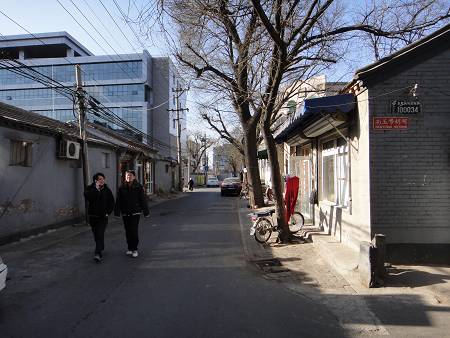
As one of the few remaining hutong in Xicheng district, Bingmasi Hutong has only partially survived the passage of modern footsteps. Normally, when the authorities demolish a hutong, they demolish the whole thing, but Bingmasi Hutong is an unusual case. While the western part was razed to the ground, its eastern half was fortunately left standing (though according to the residents, the eastern side was not preserved out of a sense of mercy towards the hutong's historical remains. Rather, the project ran out of money to demolish the rest of it). Like the North Bingmasi Hutong in Dongcheng district, its name refers to the old police department responsible for catching robbers and thieves in the region in Ming and Qing dynasties (1368-1911). Surprisingly, although nearly half of the hutong has been completely destroyed, the half that remains still maintains a meaningful connection to the area's history. The doctor is in If you knocked the door of the two-courtyard siheyuan in No.59, you might meet 40-year-old Wang. As an enthusiastic Beijinger who has lived here for half of his life, Wang can tell you about a notable former owner who lived here less than a century ago. "Xicheng district was the place producing doctors," he said proudly. "This door, for instance, was where the influential doctor Xiao Longyou (1870-1960) lived." Xiao proved to be a man of intelligence when he was just a child. In order to treat his mother who was ill for years, Xiao dedicated himself to the research of the ancient Chinese medical books that established his strong knowledge in the field. In 1892, cholera in Sichuan Province cost countless lives. Afraid of being inflected, doctors dared not to stay close to the patients. Nevertheless, Xiao voluntarily offered medical treatment and saved many lives. At that time he was 22 years old. Xiao dedicated his life to the study of Chinese medicine, treating people from the very ordinary to such influential figures as Chang Hsueh-liang, Chiang Kai-shek, Sun Yat-sen and Yuan Shikai. After 1949, he was designated the honorary president of the China Academy of Chinese Medical Sciences. For the last 30 years of his life, the patients' busy steps always called upon No.59. |
|||
| Author: Yin Yeping Source: Global Times Editor: Wu Qiong |
|||