涓枃绠€浣?/a>銆€|銆€


| 鈥淲alking into Heilongjiang鈥?series of Heilongjiang Sino-foreign cultural exchanges in history | |
http://english.dbw.cn銆€銆€
2010-12-13 10:18:36
|
|
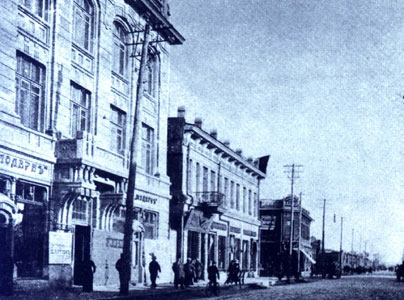 Before 1909, there had been no less than 8 cinemas in Harbin, ranking first among the metropolis in China. In 1915, the first Chinese cinema was founded by Wang Peixuan in Heilongjiang. Zhu Andong, the boss of one Harbin cinema before liberation, was one of the two richest men in Harbin. Ao Liante Cinema (Heping Cinema in Nangang, built in 1908), the earliest existing cinema in China, is in Harbin. The passport for movie release in Qiqihar, issued by Heilongjiang Negotiation Bureau to a French merchant on July 19th, 1906, is the earliest existing release permit.
In 1926, the first Russian movie magazine in the Far East was established in Harbin. Hanguang Film Company, the first film company of Northeast China, was started in Harbin in 1932, five years earlier than that of the puppet Manchukuo in 1937. With the Northeast Film Studio founded by CCP in Xingshan (modern Hegang city) in 1945, Heilongjiang Film lead the way in Chinese film development history. A number of documentary films, feature films, art films, dubbed films, scientific and educational films and slides films were shot together by Yan'an and Harbin filmmakers such as Shu Qun, Yuan Muzhi, Chen Boer and Yan Yiyan. Documentary film Democratic Northeast, feature films The Bridge, Chinese People, Medical Workers, Invisible Battleground, Zhao Yiman, open a new leaf for the Chinese film history. In addition, great progress has been made in music and dance, drama and play, literature and commercial, painting and photography.
Heilongjiang region, benefiting from urbanization of northeastern China, which originated from international culture interaction, is one of the most energetic, creative and romantic regions with great cultural consumption awareness.
鈥?/span>Overseas Russian Culture鈥?refers to Russian-style culture created by Russian writers and poets in Harbin in the first half of the 1900s and mixed culture of Russian and Heilongjiang style. As the cultural centre of overseas Russians in the Far East, Harbin once attracted and produced many well-known artists. Founded in 1926, the famous literary societies Chulajefka mostly consisted of poets, writers, painters, actors and musicians from Harbin. Activities, held every Tuesday, attracted up to four hundred people. In the following years sprung up more societies, many of which, named after Russian celebrities, promote the development of literary creation.
|
|
| Author锛? 銆€銆€銆€Source锛? dbw.cn 銆€銆€銆€ Editor锛? Yang Fan | |


| 鈥淓nter Heilongjiang鈥?Series: Origin of nation, history and culture | |
| Heilongjiang鈥檚 furniture export covers five continents | |
| Cool and exciting Heilongjiang International Ski Festival will open in December | |
| Heilongjiang enters ice and snow tour season and the hotels have risen in price | |
| Heilongjiang鈥檚 first 鈥榰nder the shaft鈥?mobile escape capsule passed the experiment stage with real character |