涓枃绠€浣?/a>銆€|銆€


| 鈥淲alking into Heilongjiang鈥?series of Heilongjiang Sino-foreign cultural exchanges in history | |
http://english.dbw.cn銆€銆€
2010-12-13 10:18:36
|
|
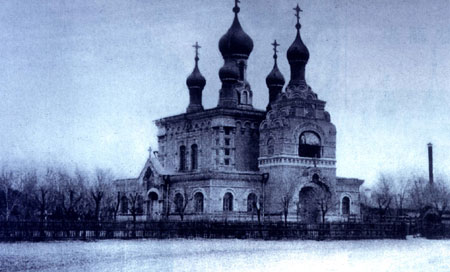
From the late Qing Dynasty, Heilongjiang was always located in Eurasia. Throughout history it has taken in many immigrants coming from Russia, Japan, North Korea and many countries through geopolitical effects. It has played an important role in North-East Asian political structure. In the process of accepting countries' immigrants, it accepted and spread Chinese culture and foreign culture.
Tsarist Russia and Japan acted as the economic expansion role. During the time of Tsarist Russia there was an 鈥?/span>Asian Yellow Russia Plan鈥?/span>, an Anti-Semitic wave and economic expansion policy transplanted some domestic Jewish industrialists and businessmen who had economic strength and operating ability in Harbin. In 1905, after the Japan-Russia war, tsarist Russia was attributed to American Jewish bankers Jacob Schiff supporting the Japanese economy. It caused another anti-Semitic wave. Jewish soldiers in China, Jews who fled to Siberia the Far East left Heilongjiang.
Harbin's opening up not only allowed Russian or Japanese nationals to come here, but also nationals from Germany, Poland, France, UK, USA, Italy, the Netherlands, north Korea, Greece, Denmark, Sweden, Switzerland, Austria, Australia, Portugal, Turkey, Belgium, Hungary, Romania, Czechoslovakia, Latvia, Estonia, Serbia, Armenia, Lithuania, India and other countries. They had arrived to find development and success. According to the statistics in 1934, there were 3256 American nationals in that year. To preserve each country's political and economic benefits, there were 19 foreign embassies or consulates in Harbin.
Modern Chinese and foreign cultures and meta-analysis, history of Huayangzachu gave Heilongjiang an all-round radiation in culture. Chinese and foreign education became popular. At the beginning of the 20th century, the new style of education 鈥?/span>Chinese learning for basics and Western learning for utilization鈥?was popular first in Harbin. There were more than 100 various schools which were set up by foreigners. Business schools, medical schools, China-Russia industrial schools (predecessor of Harbin Industrial University), Harvard University and many other schools that enabled unprecedented development of Harbin culture education. Vocational education varied, for example, medicine, business, technology, music, dance, art, massage, cosmetics, pharmacy, floristry, typing, bookkeeping, Russian, English, Japanese and French. World masters in these fields that taught in Harbin included Stanislav, Belkovsky, Si, Base, Rapin, Rodin, Olaf and Reach. Higher music and the ballet school trained many people who spread eastern and western culture. |
|
| Author锛? 銆€銆€銆€Source锛? dbw.cn 銆€銆€銆€ Editor锛? Yang Fan | |


| 鈥淓nter Heilongjiang鈥?Series: Origin of nation, history and culture | |
| Heilongjiang鈥檚 furniture export covers five continents | |
| Cool and exciting Heilongjiang International Ski Festival will open in December | |
| Heilongjiang enters ice and snow tour season and the hotels have risen in price | |
| Heilongjiang鈥檚 first 鈥榰nder the shaft鈥?mobile escape capsule passed the experiment stage with real character |