涓枃绠€浣?/a>銆€|銆€



| Getting round | |||
http://english.dbw.cn銆€銆€
2010-12-09 09:58:11
|
|||
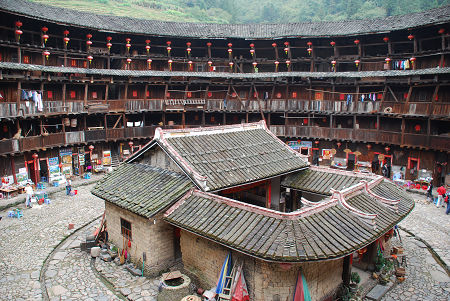
On the inside The surrounding landscape is a gorgeous combination of lush, forested hills and winding valleys of tea plantations and terraced rice fields. After a half-hour ride on the back of a motorbike, I arrived at Tianloukeng, an incredibly photogenic cluster of five tulou set on a mountain slope that looks down a valley of fertile farmland. I wandered into one of the quieter tulou and stood there for a while with my backpack on, gazing at the circular, wooden interior, until eventually a woman wearing rubber boots and holding a sickle sauntered over and offered me a room on the third floor. Naturally, I took it. Tulou in villages like Tianloukeng are geared for tourism and when you enter their gates, you are often greeted by stalls with souvenirs. Normal, communal life still continues for the Hakka, with women sorting through dried tea leaves, men making baijiu (strong white spirits) and residents cooking, washing dishes, playing cards, smoking and having a chat. I spent the next few days exploring villages by foot, witnessing firsthand life in and around these earthen fortresses. Touring the tulou There is a plethora of lovely villages awaiting exploration in Fujian. Many of them can be comfortably covered in a one-day organized tour from Xiamen. Gaobei is a village with many tulou, including the enormous Chenqi Lou, built in 1709 with a diameter of 63 meters. Regarded as one of the more majestic, Chenqi Lou is four stories high with 288 rooms and multiple rings of buildings inside the outer wall. A quieter village is Xia Ban, with numerous, superbly intact tulou spread along a shallow valley. Xia Ban is where you will find one of the oldest remaining tulou, Yuchang Lou, built in 1308. A few kilometers away is the village of Shang Ban. This is possibly the most authentic of tulou villages in Yongding - I wandered around for a couple of hours without spotting any sign of tourism. Here, in each tulou that I entered I was greeted by residents who were surprised to see a tourist. They consider their earthen abodes as home rather than a tourist site. A couple of them even offered me a nip of homemade baijiu. If you are feeling adventurous, make your way to Yongding, five hours by bus from Xiamen and then take a local bus out to the villages. This way you can move around independently, poke your head inside any tulou that takes your fancy and spend an authentic evening sleeping on the upper level and eating dinner with your host family. Getting around can be difficult due to the lack of public transport, so be prepared to pay for the occasional ride on the back of a local motorbike. <<previous [1] [2]
|
|||
| Author锛? David Sparkes 銆€銆€銆€Source锛? Global Times 銆€銆€銆€ Editor锛? Wu Qiong | |||