涓枃绠€浣?/a>銆€|銆€


| High-Speed Railway Brings Changes to Tourism Industry in Wuhan | |
http://english.dbw.cn銆€銆€
2010-11-05 16:18:51
|
|
|
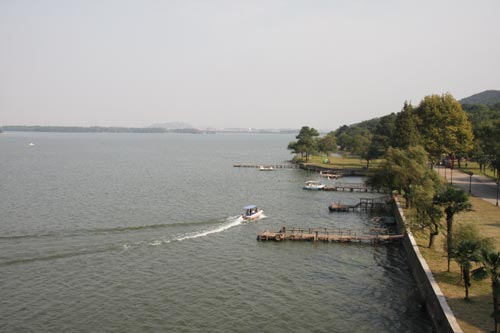
A view of East Lake, the largest city lake in the country at 33 square kilometers, in Wuhan, capital of central China's Hubei Province on Wednesday, October 27, 2010. [Photo: CRIENGLISH.com / Zhang Jin] The new Wuhan-Guangzhou High-Speed Railway that started operating last December has brought a mixed bag of changes to Wuhan's tourism industry. The city in central China which has mainly served as a departure point for outbound travelers in the past has seen an increase in the number of inbound visitors this year, especially from south China's Guangdong Province, thanks to the new railway. The high-speed line has slashed the previous travel time between Wuhan and Guangzhou from more than 10 hours to only three. It is now possible for visitors from Guangdong to pop into Wuhan on weekends, said Zhen Bie, deputy Director of the Management Committee of the East Lake Scenic Area, one of the city's most famous tourist sites. "The high-speed railway has turned long-holiday traveling into short-term leisure," Zhen said. "Now it only takes two days to go traveling in Wuhan and back to Guangdong, which used to take four to five days." Wuhan received more than 69 million visitors in the first nine months of the year, a 39.7-percent increase over the same period last year. Total tourism revenue was 54 billion yuan (around US$8 billion), up 49.5 percent year-on-year. The number of tourists visiting the city during this year's National Day holiday last month topped 5 million and brought in more than 1.7 billion yuan within the seven-day period for respective increases of 32.1 percent and 47.2 percent over last year's figures. But the increased number of visitors also has brought some challenges to Wuhan's tourism industry. Many travel agencies experienced not only a shortage of guides, but also changes in their responsibilities shortly after the high-speed railway started operating, according to Chen Weihua, deputy director-general of the Wuhan Tourism Administration. "The main business of Wuhan's travel agencies in the past was sending tourists out to other places, but it changed to receiving visitors after the opening of the high-speed railway," Chen said. "Their work responsibilities, which are now more detailed, have changed to serve the visitors and introduce Wuhan to them." The Hubei China Youth Travel Service is a case in point. The number of domestic visitors for whom the agency provided travel services to Wuhan accounted for only 10 percent of its total number of clients in the past, but has now increased to more than 20 percent, according to Luo Yi, General Manager of the agency's domestic tourism center. "We recruited many newly graduates and offered them professional training to meet the increasing demands for guides," Luo said. Still, visitors have requested more improvements in Wuhan's tourism services. "Wuhan has a good foundation in travel resources and has the potential for further development as well," said Cheng Zhaode, a senior citizen from Zhuhai city in Guangdong Province. "However, it still needs to make some effort to catch up with coastal tourism cities in tourism services and related facilities." Various city government departments have been cooperating to improve public services and facilities, Chen Weihua said. Tourist information centers put in place in May at the city's main railway and bus stations and airport have provided services for nearly 100,000 individual tourists. Additional tourist information centers are under construction in Wuhan to offer more information and travel packages to meet the diverse requests of individual visitors. The city also has been improving its transportation system and posting more signs, Chen said. "For advanced travel destinations, travel agencies only perform auxiliary functions," Chen said. "It is more important to offer more individual visitors an efficient transportation system, tourism infrastructure and an information system to create a most satisfied travel experience for them." |
|
| Author锛? 銆€銆€銆€Source锛? CRI 銆€銆€銆€ Editor锛? Wu Qiong | |