涓枃绠€浣?/a>銆€|銆€


| Zeroing in on new form of vacation | |||
http://english.dbw.cn銆€銆€
2010-10-12 10:09:03
|
|||
|
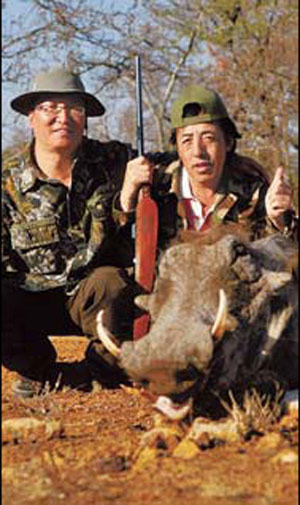
Lupien, who speaks fluent Putonghua, says there are two types of clients in China: "Those who have hunted before in China and those who have the means to go and heard by word of mouth or saw it advertised." He said South Africa was a relatively inexpensive option. "There is a huge variety of game. It is strictly controlled within the letter of the law. The climate is good. I am seeing more people taking up the sport and more repeat customers," he said. So far this year, Lupien, who has 30 years of experience as a hunter, has accompanied three groups to Africa and his order book is already filling up for next year. He brings a Chinese chef and another translator on every trip. "When you put monetary value on game, people conserve it," he said, adding that animal populations had risen by millions since hunting became controlled. Hu, the two Lis and Niu were booked by Lupien with Theo de Marillac Safaris, named after its founder. De Marillac, 37, has been in business since 1993 and runs a 40,000-acre (16,187 hectares) hunting concession around Munnik, which he has held for nine years. He has two senior professional hunters on his staff, Riaan Drotsky and Philip Botha, another professional, Jaco Cronje, and an apprentice, Fanie Malan. One hunter accompanies two guests on safari with two local African native trackers and general helps. He has worked with his head tracker, Falton Mondolme, for 17 years. De Marillac says there is a strict quota system on kills to keep the animal population sustainable. Money from hunters is ploughed back into the environment and wildlife to maintain its viability. He says his business fully conforms with the Convention on International Trade in Endangered Species of Wild Fauna and Flora (CITES), also known as the Washington Convention. |
|||
| Author锛? Mark Hughes 銆€銆€銆€Source锛? China Daily 銆€銆€銆€ Editor锛? Wu Qiong | |||