涓枃绠€浣?/a>銆€|銆€


| A salty journey | |||
http://english.dbw.cn銆€銆€
2010-06-22 11:09:07
|
|||
|
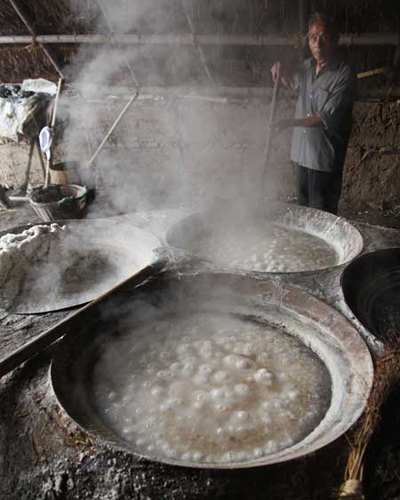
"It seems very simple but the whole process is divided into as many as 13 steps," said Xu. "I can lead you to the place where brine is produced, the most important material in the process." In another shack, almost the same as Xu Baoshan's, there were five big jars in front, three standing in the open and the other two buried into the earth. Sixty-nine-year-old Xu Kaihua, also a salt-maker, introduced himself as a brine worker and demonstrated how the jugs were sealed with clay plugs and then buried. "There is salty mud in the jar, which contains salt crystals. And the clay plug can let water through and allow it to melt the salt in mud. Then the water carrying salt will run into this container," said Xu Kaihua, pointing to a smaller jar next to it, also buried but open to the air. "We call this kind of water 'brine.' It is what you see being boiled there." Following his instructions, we poured several cups of tap water on the top. Minutes later, a cloudy stream ran out. Xu took out a tool that was similar to a wooden ladle and filled it with brine. Two small balls floated on the water's surface, but one was still submerged. "Two balls are floating, which means the brine is about 22 degrees according to our traditional measurement. If the brine meets that degree, it can be sent to be boiled," said Xu, explaining the tool is close to a Western densimeter, but was invented centuries before that. "The balls are made of resin. If all three floated, the degree would be 24.5, which is rarely seen by this method." Two hours later, the workers collected crude salt and made it into a cake just like centuries ago. It was almost 5,000 years ago that Chinese coastal people started to boil sea water to produce salt. In the Ming and Qing dynasties, salt 鈥?critical to human survival as a vital food supplement and preservative 鈥?became a valuable commodity. As a government monopoly, elite salt merchants were selected and authorized to collect taxes on salt. But these salt workers were still poor and they worshipped their own salt god, Yan'ao God to protect them. Villagers or members of the Xu family, most people living in Daxu village are surnamed Xu, still worship their ancestor, a salt craftsman surnamed Xu or their god every day. "Our big family passed on by generations, thanks to his gift in producing salt. No matter how time changes, we need to pay tribute to him," said Xu Kaihua, as well as his fellow brothers at the well-preserved temple for Yan'ao God, which lies on the main road of the village. About Xiangshan county Surrounded by sea on three sides, Xiangshan has 608 islands and a coastline of 800 kilometers. The fish culture of Xiangshan dates back to more than 6,000 years ago. Sea salt making is one of the county's National Intangible Cultural Heritage programs. There are also other cultural and historical sites spread all over the county, such as Tashan culture site, sea defense sites from the Ming and Qing dynasties, ancient pottery kilns and ancient sunken ships. Address: Daxu village, Xiangshan county, Ningbo, Zhejiang Province How to get there: Go to Ningbo by air or train, and change for bus to Xiangshan county. Take a taxi to Daxu village <<previous [1] [2]
|
|||
| Author锛? Xu Liuliu 銆€銆€銆€Source锛? CRI 銆€銆€銆€ Editor锛? Wu Qiong | |||