涓枃绠€浣?/a>銆€|銆€


| A salty journey | |||
http://english.dbw.cn銆€銆€
2010-06-22 11:09:07
|
|||
|
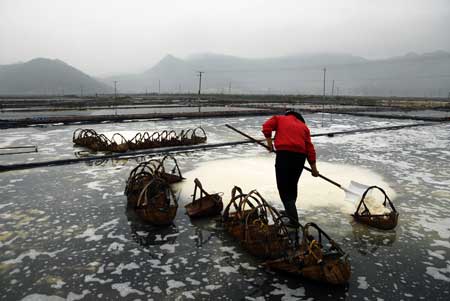
As the old Chinese saying goes, those living on a mountain live off the mountain, and those living near the water live off the water. Living close to the sea is beneficial for not only delicious seafood but also for salt. Traditional salt making was a booming industry in ancient China, but now it is on the way to being reborn as a cultural treasure and tourism business. In a wood shack, Xu Baoshan put pieces of wood into a clay stove, heating a large pot of water and salt crystals. Seventy-five-year-old Xu is one of the only craftsmen who inherited the traditional salt-making technique that's been passed down from generation to generation in Xiangshan county, on eastern China's Zhejiang Province. "They are churning up the brine to speed up evaporation, which allows the salt to be harvested," Xu told the visitors of 2010 BMW China Culture Journey, which explored cultural heritage sites and contributed millions in donations for heritage protection supported by BMW China, while his two partners churned the mixture. The salt was mostly white, but a few yellow crystals were visible. "It is not as white as what we have now, because it is crude salt, only used directly in old times. In normal cases, if one jin of firewood burned out, we would get one jin of salt," said the veteran worker, who has spent three decades in the salt industry. According to Xu, Daxu village has been involved in the salt-producing industry for 900 years. Salt making is considered a special kind of handiwork because it can be influenced by a variety of factors including climate, winds, amount of rain and so on. To make salt, they take sea water as a basic raw material, then use beach sand and salty mud (or impure ash made by manpower) under sunlight and wind power to vaporize it, while pouring and stirring the solution to make it into bittern, the salt and water solution that remains after salt has crystallized out of a brine. Then it is turned into raw salt by heating it with a wood fire. |
|||
| Author锛? Xu Liuliu 銆€銆€銆€Source锛? CRI 銆€銆€銆€ Editor锛? Wu Qiong | |||