涓枃绠€浣?/a>銆€|銆€


| Beijing artist's Phoenix gives Expo a rise | |||
http://english.dbw.cn銆€銆€
2010-05-07 10:45:05
|
|||
|
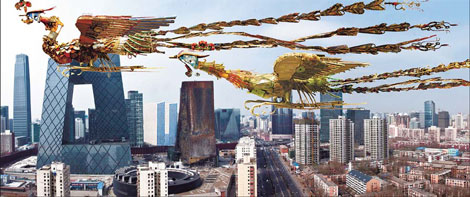
Xu Bing moved his latest installation artwork, Phoenix, to the Shanghai 2010 Expo. Set amid the shiny and modern architecture in and around the Expo Park, the 28-m-long Phoenix looks old, yet it is very special. The 12-ton sculpture - actually of two intertwined phoenixes, is pieced together from construction debris, a repurposing that melds well with the environmental theme of the world's fair. Besides shedding light on ecology, it's literally illuminating, as diodes embedded within the birds brighten the night with a constellation of patterns. It's a modernistic take on an old tradition, a task that's become a recurring theme for one of China's leading contemporary artists. Xu turned from traditional printmaking to "rebellious" installations in the 1980s. At the time, many felt he had betrayed the traditional craft. Today, traditional printmaking continues to be a dominant influence on his work. For his Book from the Sky installation, which catapulted him to fame, Xu created 4,000 fake characters and hand-carved them into wood blocks, then printed them onto volumes and scrolls. His recent work Book from the Ground - a continuation and evolution of the earlier work - uses a universal "language of icons" that he has been collecting and organizing over the last few years. Born in Chongqing in 1955, Xu grew up in Beijing. During the cultural revolution, his father, who was the head of the history department at Peking University, was denounced as an enemy of the people. As his son, Xu was implicated, too, but he worked hard to show he could contribute to society by doing calligraphy for revolutionary posters. In 1975, he was relocated to the remote countryside in northern China, where he lived two years. On his return to Beijing, he enrolled at the printmaking department of the China Central Academy of Fine Arts (CAFA) in Beijing and he became a staff member after graduating in 1981. In 1990, at the invitation of the University of Wisconsin-Madison, he moved to the United States and lived there for 18 years. However, he was recently lured back to China to become vice-president of the CAFA. |
|||
| Author锛? 銆€銆€銆€Source锛? China Daily 銆€銆€銆€ Editor锛? Wu Qiong | |||