涓枃绠€浣?/a>銆€|銆€


| Following the sacred way to the Ming Tombs | |||
http://english.dbw.cn銆€銆€
2010-04-07 09:42:46
|
|||
|
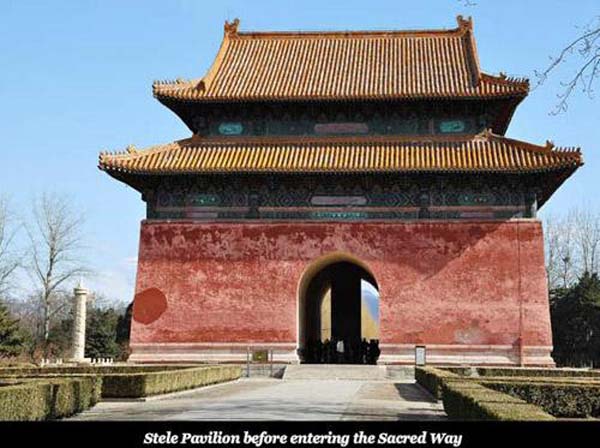
The Ming Tombs area covers some 80 square kilometres. The three main tombs that draw tourists are Changling, Dingling and Zhaoling. Changling mausoleum is undoubtedly the most magnificent of the three main tombs here. Changling is the tomb of Emperor Zhu Di, often referred to as Emperor Yongle. It is also the burial site of his wife, Empress Xu. In fact, it was after the death of his wife, Empress Xu, at the age of 45, that Emperor Yongle ordered the building of the mausoleum out in this valley. This tomb alone took 18 years to construct. Emperor Yongle is known to many as the monarch who ordered that the Imperial capital be moved from Nanjing to Beijing. He also ordered the construction of the Forbidden City, and during his reign there were numerous notable achievements such as the compilation of the Yongle Encyclopedia, as well as the voyages of Zheng He. But when this great emperor passed away in 1424 at the age of 64, he was not laid in his mausoleum alone. He was entombed with his wife, Empress Xu, who had died 17 years before him. And, his concubines were buried with him too. In fact, Emperor Yongle had about 30 women hanged so that they could be buried with him and accompany him on his journey into the afterlife. The practice may sound quite shocking today, but Emperor Yongle would not have batted an eyelid at such a practice. After all, this is the man who ordered and then witnessed 2,800 women being slowly sliced to death in front of him after he concluded that the death of one of his concubines was due to poisoning. The practice of entombing living concubines, however, was abolished during the reign of Emperor Zhengtong in the mid-1400s. Emperor Zhengtong's tomb is known as Yuling, and is, like the other Ming Dynasty emperors, built around mausoleum where Emperor Yongle lies. The best approach to the Changling, the mausoleum of Emperor Yongle, is along the Sacred Way, a seven-kilometre-long colonnade. This divine pathway is lined with willow trees, and as you make your way along the colonnade you stroll past life-size statues of camels, lions and elephants. You will also view statues of Chinese mythological beasts. And, as you reach the end of the Sacred Way you come across the statues of generals and other dignitaries. |
|||
| Author锛? 銆€銆€銆€Source锛? china.org 銆€銆€銆€ Editor锛? Wu Qiong | |||