 涓枃绠€浣?/a>銆€|銆€


| Sea to Believe | |||||||||||
|
|||||||||||
http://english.dbw.cn銆€銆€
2012-06-28 10:14:39
|
|||||||||||
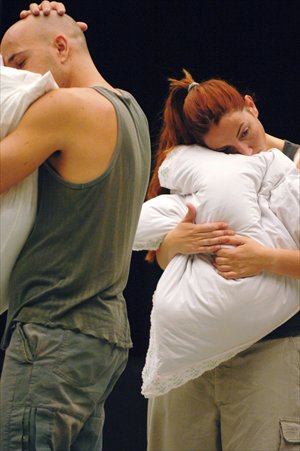 At Sea is based on the namesake book by master of Hebrew prose S. Yizhar. Photo: Courtesy of the Ruth Kanner Theatre Group
The two stories Israeli director Ruth Kanner tells in At Sea are simple yet familiar at their core in the humanity they exude. The first centers on a young couple discovering their first love on the shores of the Sea of Galilee, while the other follows the plight of a man who drowns after being pushed by his friends to swim in the Mediterranean Sea. With her creative theater storytelling techniques and tense physical movements, the director succeeds in framing the compelling stories written in literary texts as primal human struggles of love and death in a powerful 90-minute drama performed by the Ruth Kanner Theatre Group. Embracing the art of storytelling, a practice Kanner has been devoted to since the early 1980s, she presents an explicit interpretation of the texts written by late Israeli writer S. Yizhar, whose namesake novel the play is based upon. The subtle texts, which largely are reflections of the human soul, set against the idyllic backdrop of Israel's coast, remain true to their literary form and avoid being dramatically embellished. Actors make up fewer than half the number of characters in the play, meaning the cast takes turns to narrate the stories rather than acting them all out. Physical movements accompany narration sporadically throughout the production. "Drama, most of the time, has one point of view, but a story can be told by different storytellers. When you deal with storytelling, you always deal with different points of view," said Kanner of the play, which will appear at the Third Nanluoguoxiang Theater Festival in addition to a having three-show run at Beijing's Penghao Theater from today through to Saturday. Storytelling can open audiences' minds, she added, saying it is a "strong way of keeping in touch with your roots, both culturally and personally." "If each person sees a story from a totally different perspective, each person sees a different 'truth' and can develop greater tolerance for others," she said. Chinese drama director Zhang Ziyi, who viewed the troupe's rehearsal last year in Tel Aviv, stressed that the essence of the story matters "far more than how it's told." "When [Kanner] tells the stories of inner conflicts among characters, she is not focusing on dramatic elements. Instead, she uses other methods including narration or physical movements, thus bringing out conflicts hidden in the stories or by the narrators," Zhang said. Since Kanner's namesake troupe formed in 1998, her efforts in adapting literary texts about traditional Jewish culture to the stage have offered her opportunities to explore theatrical limits, making her group one of the most popular troupes in Tel Aviv. "I've seen a lot of pretending on stage. To me, it's bull****. The rule in our theater is to never imitate. When you ask yourself actively how should I represent this image on stage, you have to ask questions about the essentials," Kanner explained. What At Sea lacks in drama, it makes up for with graphic visual imagery on stage. To deliver stories in a raw, engaging manner, actors bring their personal feelings and experiences into the performance. The primary principle of adopting the storytelling technique, noted the director, is to stay true to the plot. The sea, the central theme within both stories, is actually depicted as a metaphor. Violent struggles to avoid drowning are actually struggles with social pressures, aptly represented by other actors on stage. "The theatrical interpretation is about people and the way a person in life struggles against others," Kanner explained of the play, which will be shown in English and Hebrew with Chinese subtitles. When: 7:30 pm, June 28-29/2:30 pm, June 30 Where: 35 Dongmianhua Hutong, Jiaodaokou Nandajie, Dongcheng district Admission: 40-80 yuan Contact: 6400-6472 |
|||||||||||
| Author锛? 銆€銆€銆€Source锛? global times 銆€銆€銆€ Editor锛? Yang Xiaoming | |||||||||||


