涓枃绠€浣?/a>銆€|銆€


| A manmade natural wonder | |||||||||||
|
|||||||||||
http://english.dbw.cn銆€銆€
2012-06-15 18:29:01
|
|||||||||||
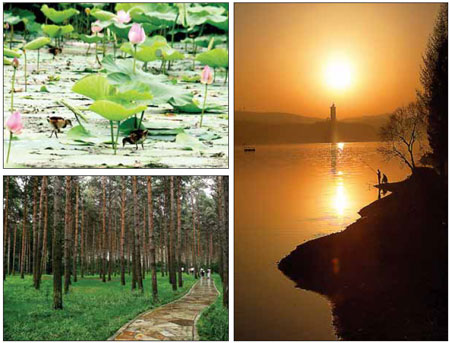 Blooming lotus flowers form a picturesque Jingyuetan, or Clear-Moon Lake, in summer. Jingyuetan is a popular destination for outdoor activities like fishing, mountaineering and boating. The 4.3-sq-km lake is located at the heart of a 96-sq-km park in Changchun, Jilin province. Visitors stroll along the trail to enjoy the forest, planted in the 1930s. Photos Provided to China Daily Asia's largest planted forest offers delights for every type of visitor. Zhu Zhou reports in Changchun. Every city has a downtown, but not every city has a nature reserve so pristine that many wish their homes were there. Only 20 km to the southeast of downtown Changchun, capital of Jilin province, is Jingyuetan, or Clear-Moon Lake. The lake itself is only 4.3 sq km, but it brings a sparkle - or sparkling water to be exact - to the 96-sq-km park that surrounds it. It is "Asia's largest manmade forest", says Zhang Zhanhai, general manager of Changchun Jingyuetan Tourism Development Group Co, the State-owned company that manages the park. The trees were planted in the early and mid-1930s after the puppet government of Manchukuo set up its capital in the city. Now, they have added a rich texture of green to the landscape. As the seasons change, the place shimmers with wondrous serenity of every kind. However, this is also a place where sports aficionados indulge themselves. You can ski in winter and go boating in summer. An 18-hole golf course is being expanded. Vasaloppet, a ski event licensed from Sweden, has been held here for a decade. On a stone obelisk imported from the Scandinavian country, one side has been carved with the names - mostly Swedish and Chinese - of competition champions. "It'll take three more decades to fill all four sides," Zhang Zhanhai says. But you do not have to be a professional athlete to enjoy the park. Most of the 1 million visitors who came here in 2011 went for something as simple as a stroll around the lake. There are touristy places, akin to a city park, where you can wind down and take photos. But there are also wilder areas with less traffic. The park is building a boardwalk that will eventually encircle the whole lake, extending 18 km and separating motor traffic from pedestrians and hikers. The elderly like to come here for exercise, Zhang says. Some fitness-conscious citizens visit as often as three times a week. That is mostly facilitated by the park's pricing strategy. "We charge only 30 yuan ($4.70) for a regular ticket - much lower than the entrance fee for a similar venue (in other cities)," Zhang says. "If you buy a 120-yuan annual ticket, you can come every day." The ticketing revenues fall far short of the upkeep, though, let alone new constructions. "We invest 100 million yuan in it every year," Zhang explains.
|
|||||||||||
| Author锛? 銆€銆€銆€Source锛? China Daily 銆€銆€銆€ Editor锛? Yang Xiaoming | |||||||||||