涓枃绠€浣?/a>銆€|銆€


| China brings warm spring to private economy | |||||||||||
|
|||||||||||
http://english.dbw.cn銆€銆€
2012-03-20 08:57:16
|
|||||||||||
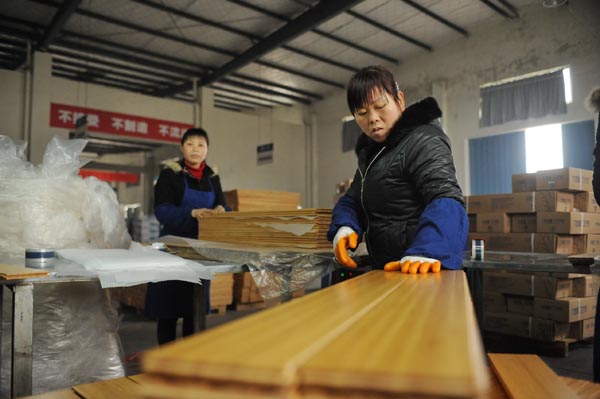 Workers manufacture bamboo floor boards in a company of Nanchang County, east China's Jiangxi Province, March 15, 2012. Jiangxi Province took measures in a variety of levels, such as establishing a provincial credit guarantee Co., Ltd with the fund of local government, to promote the development of small- and middle-sized enterprises. (Xinhua/Zhou Mi) Chinese government's package of economic policies aiming to boost the non-public economic sector and private investment would ignite the hope to trapped small businesses, analysts said. In the report on the work of the government, Premier Wen Jiabao pledged to develop the non-public sector of China's economy by breaking up monopolies and relaxing restrictions on market access. He added that China would lessen tax burdens on small and micro-sized businesses and increase credit support to them. Besides, a train of measures also were promised in the report to alleviate the credit crunch of small and micro-enterprises, including encouraging small financial institutions to offer more money to small private businesses, which have cheered the hearts of many entrepreneurs. In response to Premier Wen's call for relaxing restrictions on market access for private capital, Zhang Ping, minister in charge of the National Development and Reform Commission, said relevant policies would come out in the first half of this year. To make financial services more accessible, Chinese government will actively cultivate small-scale financial institutes to target small- and micro-sized businesses, adding that the government will work to properly guide private financing, according to a statement released by State Council. The chilly winter of long-suffering private economy in China seems to thaw into springtime. WIDENING CHANNEL FOR PRIVATE INVESTMENT China will guide private capital into the development of real economy by easing restrictions on market access, according to recent official statements. Premier Wen pledged to adopt further measures to encourage private investment in monopoly industries to address problems with China's economic structure. The government proposed policy improvements in the non-public sector to encourage private capital to enter fields that were previously monopolized by the state, including railways, municipal administration, finance, energy, telecommunications, education and health care. China launched a new investment fund March 12, which will mainly look for investment opportunities in infrastructure facilities such as oil and gas pipeline construction. Wen said private capital should be encouraged to flow to fields such as finance, energy, transport and social services, "which can not only alleviate the difficulties of economic development but also accelerate the development of these causes." Zhou Tienong, vice-chairman of China's top legislative body, said reform of monopoly industries in China has lagged far behind and resulted in unfair competition. The State Council, China's Cabinet, has urged all relevant departments to publish detailed implementation rules for the 36-article circular, which was released by the central government in 2010 to boost private investment in various areas, said Huang Mengfu, who is also vice chairman of the National Committee of the Chinese People's Political Consultative Conference (CPPCC). "The entry of non-public sectors into state-monopolized sectors is an important step of economic reform, creating favorable conditions for private enterprises," Huang added.
|
|||||||||||
| Author锛? Tang Danlu 銆€銆€銆€Source锛? xinhua 銆€銆€銆€ Editor锛? Yang Xiaoming | |||||||||||